
Industry Solutions
Healthcare & Hospital SPD
High-value consumables visible from the storeroom to the theatre.
Where the day goes wrong
The month-end count never matches.
High-value consumables leave the store on a tray and come back as a handwritten note. By the time the numbers are reconciled the gap is weeks old, and nobody can say which case used what. Read the item as it leaves and returns, and the count is current the same day.
Why it is hardConsumables are a mixed-material problem. UHF passes through most sealed packaging, which is why a tray can be read without opening it, but the two contents that change the answer are liquid and metal - a saline bag absorbs the field, a stainless instrument reflects it. A count that is right for gauze is not automatically right for a tray of both.
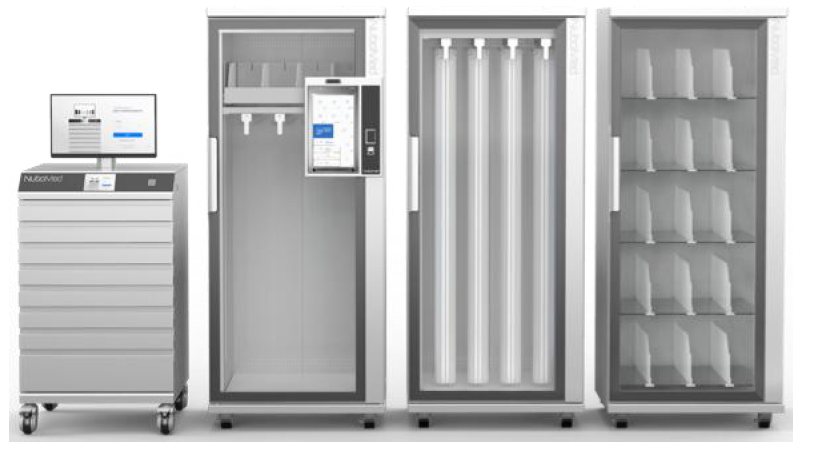
Our partThat is why we test on site with the actual tray rather than a sample of the packaging. The JNI-YL01 and JNI-YL02-M medical cabinets are set up for the stock you actually hold, so the count is current the same day rather than weeks old.
Every handover is logged by hand.
The SPD cart is signed over item by item at the nurse station while a case waits. Read the whole cart at the handover and the signature becomes a scan.
Why it is hardA handover is a batch read, and a batch read is exactly what the air interface is built for: the cart is one inventory round, and the read set is compared against what the cart is supposed to contain. The signature becomes the difference between the two lists rather than a line-by-line transcription at the nurse station.
Our partThe JNI-TM08 and JNI-TM09 shelves keep a live count at the point of storage, and the JNR-DSE desktop readers cover the issue desk where a cart is checked in the same place every time.
Equipment is found only when it is wanted.
A pump or a monitor is missing at the moment a theatre asks for it. Track the item as an asset and the answer is on screen, not at the end of a corridor.
Why it is hardLocating an asset is a different problem from counting it. A fixed read point in a corridor or a store gives room-level presence without line of sight, and a handheld covers everything between the fixed points. The asset answers with its own identity, so the answer is on screen rather than at the end of a corridor.
Our partA JNR-E401N or JNR-E801N with JNA series antennas covers the fixed point, and the JMDS65 handheld covers the rounds. We do not publish hospital names or patient data, and the record stays in the system you already run.
How RFID reads a tray
In a hospital store the reading problem is packaging. A passive tag is powered entirely by the reader's field, so anything between the antenna and the tag subtracts from the power budget: a sealed tray is usually fine, a liquid bag is not, and a stainless instrument next to a tag shifts its tuning. UDI and sterilisation-cycle traceability are the reference points we design the reading and the records around.
- Reads through sealed packaging
- Liquid and metal are the two detuning cases
- UDI-aligned identification
We design the reading side and test it against your trays on site. Labels and media stay with your current supplier.
What goes on the floor


Desktop readers
For issue desks and close-range work.
JNR-DSE01 · JNR-DSE03 · JNR-DSE04 · JNR-DSE06
View the JNR-DSE family
Storeroom reading and handheld
Fixed readers with JNA series antennas, plus a handheld for rounds.
JNR-E401N · JNR-E801N · JNA series UHF antennas · JMDS65
View the JNR-E familyWhat hardware does this industry usually deploy?
A working configuration for this industry, taken from the equipment listed above. The band column gives the UHF RFID standards the hardware is built to.
| Role on site | Recommended models | UHF band | What it does |
|---|---|---|---|
| Medical cabinets | JNI-YL01 · JNI-YL02-M | 902-928 MHz (US) / 865-868 MHz (EU) | For consumables and general medical stock. |
| Smart shelves | JNI-TM08 · JNI-TM09 | 902-928 MHz (US) / 865-868 MHz (EU) | Live count on open stock, with a weighing option. |
| Desktop readers | JNR-DSE01 · JNR-DSE03 · JNR-DSE04 · JNR-DSE06 | 902-928 MHz (US) / 865-868 MHz (EU) | For issue desks and close-range work. |
| Storeroom reading and handheld | JNR-E401N · JNR-E801N · JNA series UHF antennas · JMDS65 | 902-928 MHz (US) / 865-868 MHz (EU) | Fixed readers with JNA series antennas, plus a handheld for rounds. |
How it runs
- Consumable issue and return The item is read as it leaves the store and again when it comes back.
- SPD handover The cart is read as a batch at the nurse station, instead of signed over item by item.
- Equipment location and stock-take Assets are counted where they sit, and a missing unit shows up before someone needs it.
Questions we get
Can this support UDI and sterilisation-cycle records?
Will a cabinet read through a sealed tray?
Does it connect to our ERP?
Tell us what you count.
Send the categories, the volumes and where the pain shows up, and we will come back with a cabinet and reader mix.
Email support@jnxrfid.comRelated industries: Supply chain & logistics · Manufacturing & industrial tooling · Apparel & fashion retail · New energy & utilities · Banking & archives · Public sector & public assets · Aviation MRO & ground support · Anti-counterfeiting & traceability · How we deliver
Contact: support@jnxrfid.com · All industry solutions