
JNXRFID · Know-how Series · Deployment Reality KH‑005
The Label Is Part of the System, Not an Accessory
Steel is the hardest surface in RFID, and the fix is not a stronger reader. It is a tag construction chosen for the surface, mounted at a distance from that surface, in a position that survives how the asset is actually handled.
13 min read · Applies to UHF passive RFID on metal · Mounting, spacer and orientation · First edition, October 2026
Our tools are steel, our labels are ordinary RFID inlays, and the read rate is poor. The reader has already been upgraded once. What is actually wrong, and how do we specify a label that will work on metal?
An ordinary inlay placed directly on steel is effectively shorted: the metal completes the antenna circuit and detunes it, so the tag draws power and radiates far less efficiently than its specification assumes. On-metal constructions exist to solve exactly this, by holding the antenna a controlled distance away from the surface. Choosing the wrong construction, or the right construction mounted at the wrong spacing, produces the same symptom, which is why reader upgrades have not helped you.
What metal does to a passive tag
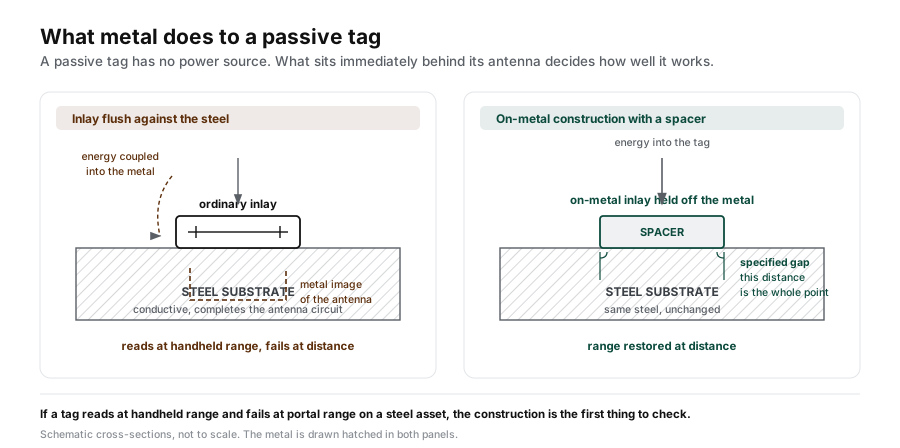
A passive UHF tag has no power source. It receives the reader's field, converts part of it to electricity, and uses that to drive its own transmitter. Everything about that chain is sensitive to what sits immediately behind the antenna.
Placed directly against steel, the metal image alters the antenna's impedance and couples energy out of the antenna rather than into it. The tag still works, which is why the problem is confusing: it will read at close range on a handheld, and simply stop being readable at the distance your application needs.
This produces a characteristic symptom worth recognising immediately. If a tag reads reliably at handheld range and fails at portal range, and the asset is steel, the tag construction is the first thing to check — not the reader, and not the power.
The spacer is the whole point
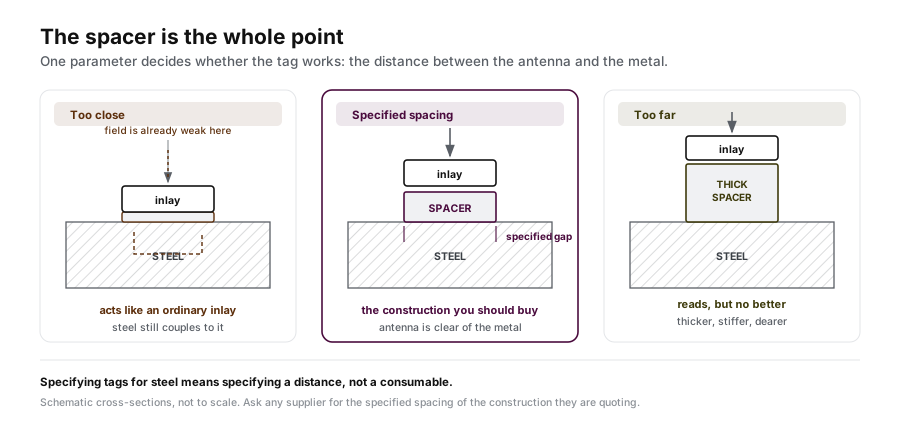
On-metal tag constructions place a spacer between the inlay and the metal. That distance is the single parameter that makes the tag work, and it is specified in millimetres for a reason.
- Too close. The metal still couples into the antenna and the tag loses sensitivity, the same as an untagged surface.
- Too far. The tag sits outside the surface effect and behaves like an ordinary inlay in free space, which is fine, but it also stops lying flat, and a lifted tag is an orientation problem waiting to happen.
- Correct. The tag reads as designed, and it tolerates the manufacturing variation that handheld application would expose.
The practical consequence is that "RFID label" is not a sufficient specification for a steel asset. The specification has to name the construction as an on-metal type, the spacer, and the operating surface, because the same tag number behaves differently on steel, plastic and cardboard.
| You specify | What the installer receives | Result on steel |
|---|---|---|
| Generic UHF inlay | A tag designed for free space or cardboard. | Shorted by the surface. Reads close, fails far. |
| On-metal tag, no spacer stated | Usually correct, but unverified. | Depends entirely on what arrived. |
| On-metal tag with stated spacer | A verifiable specification. | Predictable across batches and assets. |
Where on the asset, and what survives handling
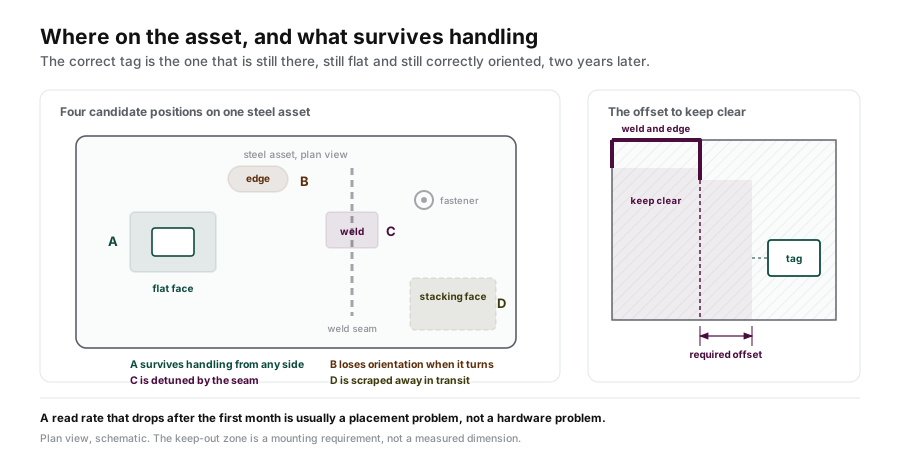
A tag that reads when it is installed can still fail in service, because the asset moves. Metal assets are handled, racked, wiped down and repositioned far more than any other inventory.
The positions that survive handling share three properties:
- Protected from abrasion. A tag on a face that gets wiped, dragged or rubbed loses its antenna before it loses its adhesive. Edges, recesses and the underside of a lip wear slower than a flat face.
- Stable in orientation. A position that lets the asset rotate in place is a position that will be read at a bad angle eventually. Mount on a face that is constrained by the way the asset sits in its rack.
- Visible enough to install, hidden enough to survive. A mounting position nobody can see is a mounting position nobody will ever apply consistently.
For tools and returnable assets, another factor dominates: the asset itself often moves between sites. A tag positioned for a portal at your facility may face a completely different direction in a customer's yard, which is why handheld and portable-read approaches are worth evaluating alongside fixed portals for this category.
How much variation to design for
A metal asset is not a controlled surface. It has welds, ribs, handles, curvature and paint thickness, and the read rate on a fleet of the same tool model will vary with all of them. The useful question is not whether every tag reads at maximum range, but what proportion reads at the range the application needs.
| Verify | How | Why it matters |
|---|---|---|
| Tag reads at range, not handheld only | Read at the application distance, not at 30 cm. | Handheld success is the symptom that hides the failure. |
| Reads through the worst surface | Test bare steel, painted steel and any coated variant. | Paint and coating change the surface effect. |
| Survives handling | Re-read after a cycle of real use, not after installation. | Abrasion is a time-based failure, invisible on day one. |
| Orientation held in service | Check after racking, not on the bench. | Orientation is decided by the rack, not by the label. |
| Failures grouped by asset position | Tabulate read rate by mounting position. | A position problem looks like a tag problem until tabulated. |
Test to run this week
Take ten steel assets from service, not from the store room. Apply one candidate tag at one candidate position to each. Read all ten at the application distance. Then compare against the same tag on a plastic asset of similar size. If the plastic assets read reliably and the steel ones do not, the material is your variable and no reader change will move it.
A diagnostic sequence that puts hardware last
| Step | What you do | What it rules out |
|---|---|---|
| 1 | Confirm the failing asset is metal, and read it handheld at 30 cm. | A total no-read points to a damaged or wrong tag, not a tuning problem. |
| 2 | Read at the application distance instead of at handheld distance. | Separates "does not work" from "does not work far enough", which have different causes. |
| 3 | Confirm the tag is an on-metal construction with a spacer. | The most common cause on steel assets, and the cheapest to correct. |
| 4 | Check the mount: surface, orientation and protection from wear. | Finding whether failures cluster by position rather than by asset. |
| 5 | Compare the same tag on a non-metal asset nearby. | Confirms the material is the variable, not the reader or the zone. |
| 6 | Only now, review reader and antenna hardware against the measured requirement. | Now a hardware decision rests on evidence. |
What to specify when you buy tags for steel
- On-metal construction, with the spacer distance stated.
- The operating surface named: bare steel, painted steel, or both.
- Orientation stated, and expressed as a mounting instruction rather than a diagram alone.
- A mounting position defined against how the asset is racked and handled, not against how it looks on a bench.
- Verification performed at the application distance, on assets taken from service.
Tag selection is the cheapest variable in the whole system to correct and the most expensive one to ignore, because it is specified once and then deployed thousands of times. It is worth more attention than the reader shortlist.
From diagnosis to a tag specification
Write the tag specification before the order
An on-metal label is specified once and deployed thousands of times. The four fields that decide whether it works are the construction, the spacer, the exact position on the asset and the surface preparation.
- Name the construction as an on-metal type, and the spacer, in millimetres.
- Test ten assets taken from service, not from the store room.
- Tell us the asset, the surface and the daily label volume; we will match the construction and the printer to it.