
JNXRFID · Know-how Series · Deployment Reality KH‑001
Why Your RFID System Works in the Lab and Fails on the Line
The most common question we are asked after a pilot is not about readers. It is: it read one hundred percent on the bench, and on the floor it reads sixty. This article explains why that is the expected outcome of a bench test, and how to find the real constraint before you spend money on hardware.
14 min read · Applies to UHF passive RFID · Reader, antenna and tag variables · First edition, October 2026
Why does our system read perfectly in the test lab but consistently miss tags during live operational shifts?
The bench and the production floor are not the same environment, and the difference is not a matter of degree. A bench test is the best possible case: one tag, one distance, no movement, perfect alignment, an empty room. A production floor is the worst case, and it changes every variable at the same time. The result is not a defective reader. It is a validation method that measured the wrong thing.
What a bench test actually measures
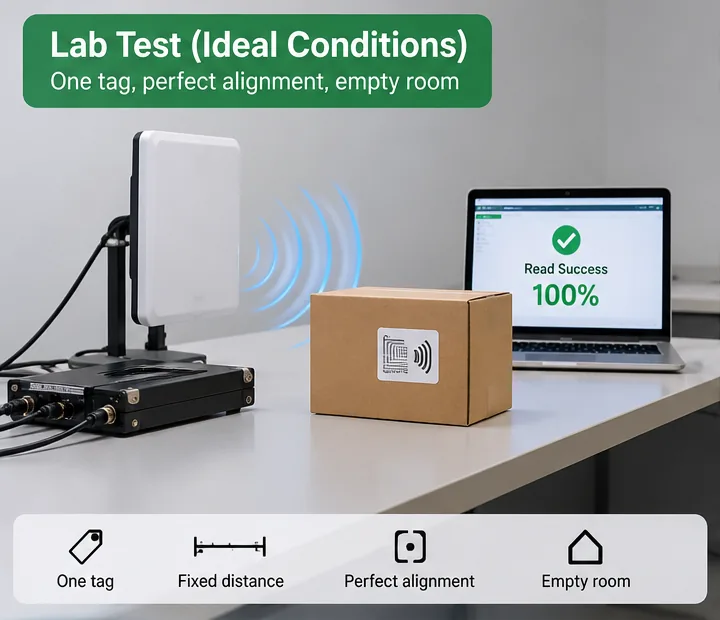
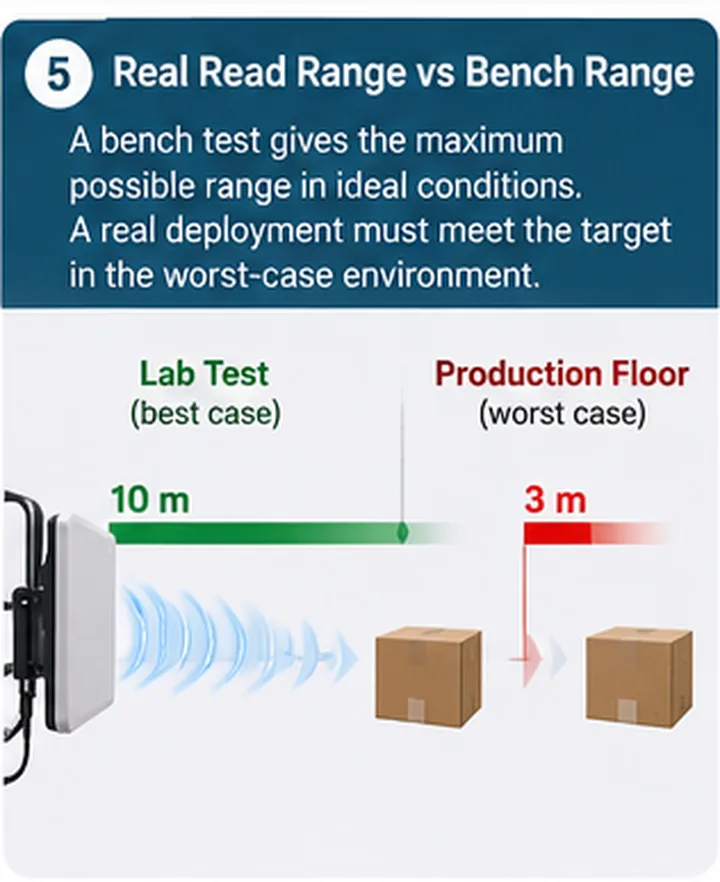
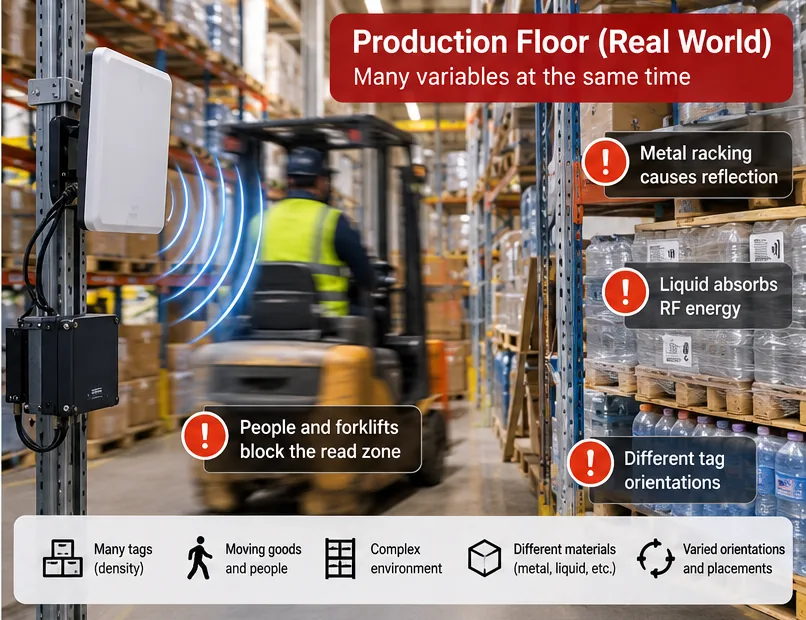
A bench validation proves that a reader can decode a tag under favourable conditions. That is a genuine result, and it is also almost never the question a deployment has to answer.
What a bench test holds constant is everything that changes in production:
- One tag, not a population. A single tag answers back at a moment of its own choosing. Fifty tags must share the air, and their replies collide.
- Static alignment. On a bench you place the tag square to the antenna. On a floor, a pallet gets wrapped, a tool gets racked at an angle, a case gets turned.
- An empty room. Bench tests are usually performed away from the structure that a real site is built out of.
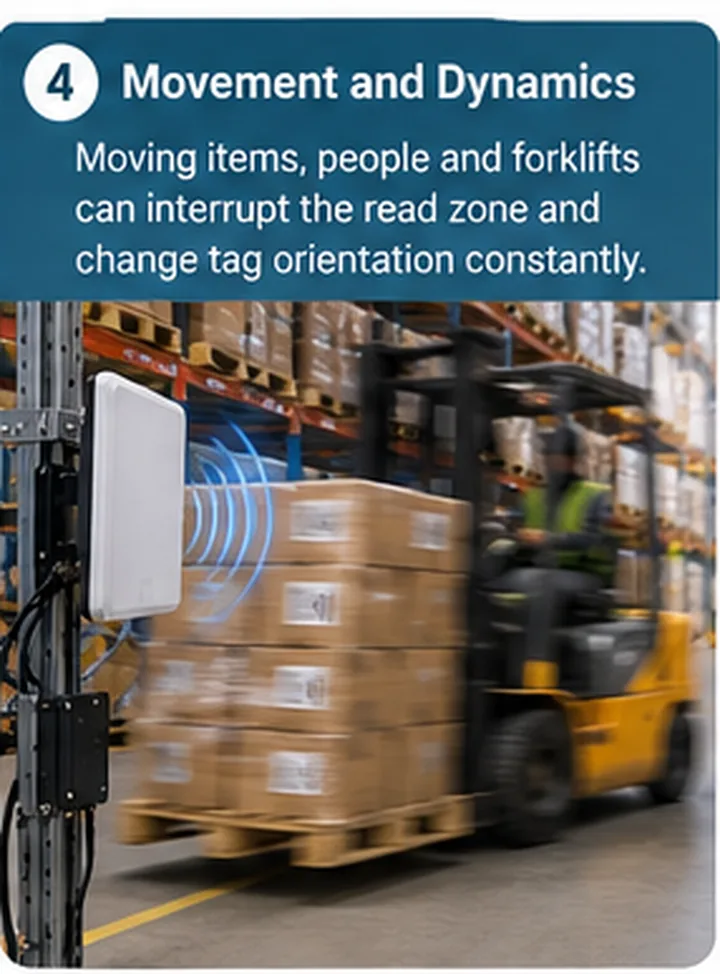
- Nothing moving through the field. People, forklifts and goods physically interrupt the read zone many times an hour.
- A surface you chose. You tagged the box that happened to be in front of you, not the oil-filled steel crate that actually fails.
Variable one: environmental interference
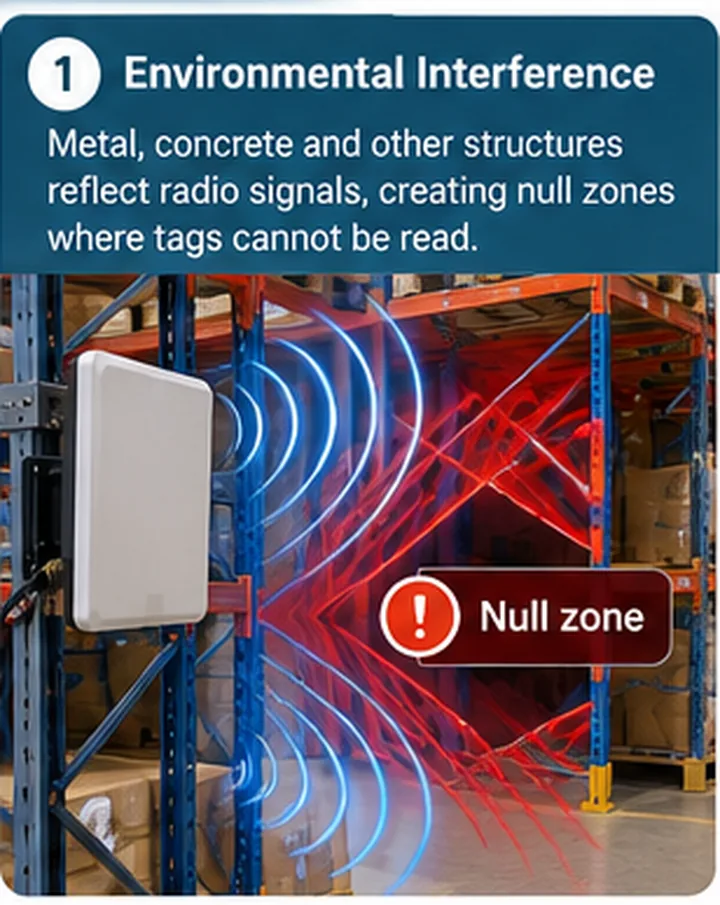
A passive UHF tag has no battery. It receives the reader's signal, powers itself from it, and returns a weak reflected reply. That reply has to travel back through the same air that carried the outgoing signal.
That architecture is why reflective environments matter so much. When radio waves meet steel racking, concrete structure or metal containers, they reflect. The reflected wave and the direct wave arrive at the tag slightly out of step, and where they cancel each other, the tag receives almost nothing.
Null zones are the confusing part
These cancellation points are called nulls, and they are why a system can behave in a way that looks like a fault:
- A tag that reads reliably can disappear entirely at one specific position, then return a few centimetres away.
- Moving an item one shelf position can change the result completely, with nothing else changed.
- Antennas placed at two positions can both be fine individually and interfere with each other once both are running.
None of this is a malfunction. It is the expected behaviour of a reflected signal, and it is why read distance measured in an open room is not a number you can plan a warehouse with.
Liquid and people
Water and high-moisture materials absorb RF energy heavily. A pallet of bottled product, a damp goods-in area or a chilled cabinet behaves nothing like a cardboard box. Human bodies absorb and scatter as well, which means a crowded aisle is a different environment from an empty one, and a system validated on an empty aisle can fail during a shift.
Variable two: tag design and placement
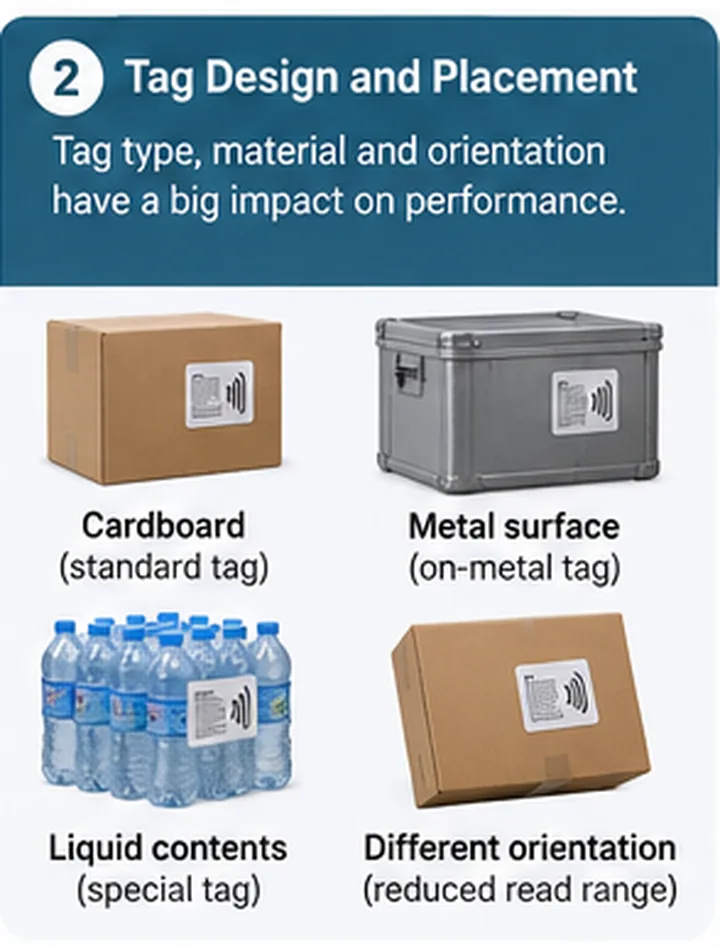
When a read rate drops on a specific group of items, the first suspicion should be the tag, not the reader. Two properties dominate.
Orientation and polarization
A passive tag reads best when its antenna geometry is presented squarely to the reader's field. This matters because a linear antenna and a circular one behave differently, and because an antenna pattern is directional. Tilt a tag by ninety degrees and you can lose most of the read range you had. Rotate an asset in its rack and the orientation changes by an amount nobody wrote down.
The material under the tag
Tag construction and the asset it is stuck to are a single system. A conventional inlay on metal is effectively shorted; an on-metal construction is designed around that fact. Liquid contents, wet cardboard and dense packed goods all degrade performance in their own way. This is the subject of our separate guide on tagging metal assets, and it is worth reading before you order labels, because the label choice is far cheaper to correct than the reader choice.
Test to run this week
Pick the ten items that actually fail in production, not the ten on your bench. Read each one handheld, in its final orientation, on its final surface, at the distance your application requires. Record which ones read and which do not. You will usually find that failures cluster by material or by orientation rather than spreading randomly — and that cluster is your real cause.
Variable three: density and anti-collision
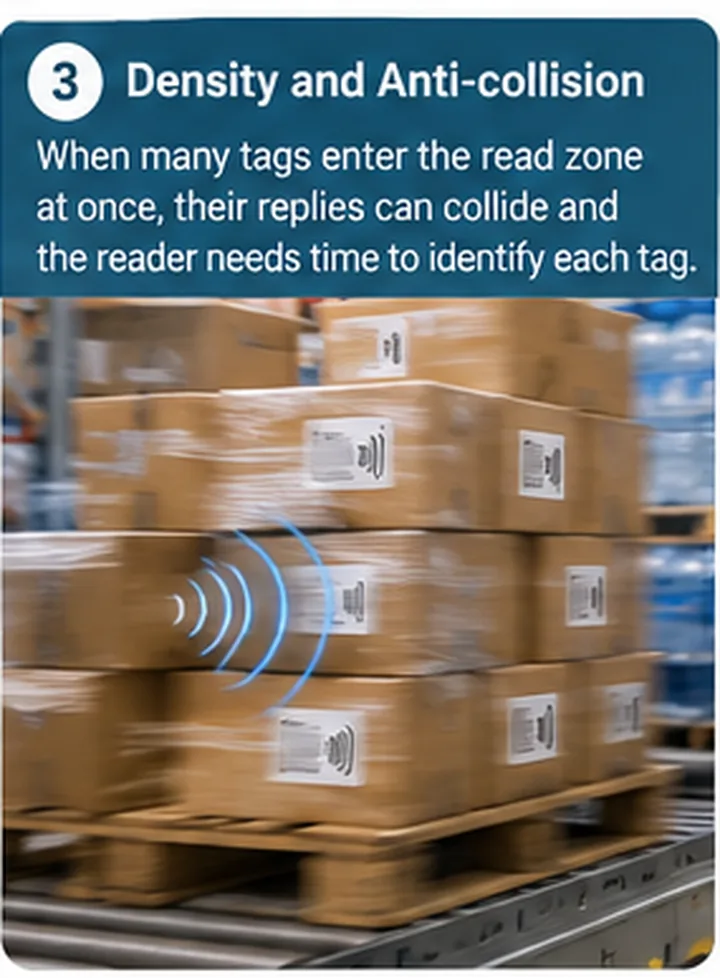
The third variable is not interference at all. It is queueing.
When many tags enter one read zone at once, each one may reply in the same instant. The reader detects the collision, picks one tag, asks the rest to wait, and repeats. Every repeat costs a full round trip.
The visible symptoms are exactly what operations teams report: the count is correct eventually, but the system feels slow, the screen lags, and under a heavy load it appears to drop tags. Nothing is wrong with the reader's sensitivity; it is spending its capacity on repetitions.
Two mechanisms make this worse:
- Electromagnetic coupling between close tags. When valuable items are stacked or bundled tightly, their antennas interact with each other and detune, so a tag that reads alone fails when it is next to its neighbours.
- Oversized read zones. If one antenna covers a full pallet position, it also covers whatever is next to it. Dividing a large field into several smaller zones usually improves throughput more than any hardware change.
A diagnostic sequence that avoids wasted hardware
Most failed deployments follow the same path: a short read distance is observed, a more powerful reader is ordered, and the situation does not improve, because the reader was never the variable that changed. The reader did not move. The room did.
This sequence separates cause from symptom, and it deliberately puts hardware last.
| Step | What you do | What it rules out |
|---|---|---|
| 1 | Freeze every variable except one: same tag, same orientation, same surface, same distance. | Removes randomness. Most “intermittent” faults are just several variables changing together. |
| 2 | Read the failing item handheld, in place, in the real orientation. | If it reads, the fixed installation is wrong: position, coverage or power. If it does not, go to step 3. |
| 3 | Re-read the same item on a different surface — cardboard, then the real metal or liquid-filled asset. | Separates the environment from the reader. A reader that fails on one material only is fine. |
| 4 | Audit orientation and mounting on the asset, including where it ends up after handling. | Finds alignment loss, which power cannot recover. |
| 5 | Count how many tags share one read zone, and reduce it. | Finds queueing and tag-to-tag coupling before you blame throughput. |
| 6 | Only now, compare reader and antenna hardware against the measured requirement. | Now a hardware comparison is against evidence rather than against a benchmark. |
What to measure instead of what to believe
The conversation with your supplier changes depending on which of these you bring. Bench figures are the easiest to obtain and the least useful on a floor.
| Measure | Why it matters |
|---|---|
| Read rate on the production-representative surface | It is the only number that transfers to the real site. Everything else is an estimate. |
| Read rate with floor traffic running | Blocked fields and moving stock are operating conditions, not edge cases. |
| Tags per read zone | Predicts queueing and lag far better than reader specification sheets do. |
| Failures grouped by material | Converts an intermittent complaint into an addressable engineering list. |
| Cross-reads outside the intended zone | Becomes a real problem the moment an adjacent zone exists. |
What this means when you evaluate equipment
A supplier who quotes a read distance should be willing to explain the room it came from. The useful questions are short:
- On what surface was that distance measured, and with the tag in what orientation?
- What was the tag count inside the zone when you measured it?
- Have you tested this on metal or liquid-filled assets, or on cardboard?
- What is your procedure when a deployment fails the floor test after acceptance?
If you are planning a pilot of your own, our evaluation unit is intended for exactly this purpose: testing on your assets, on your floor, before a purchase decision rather than after it. That reverses the order of operations that produces most of these failures.
From benchmark to pilot
Run the pilot on the floor, not in the lab
The gap between a bench number and a production read rate is not a defect to be argued about. It is a set of three measurements, and a pilot that collects them costs far less than a hardware upgrade that answers none of them.
- Measure the same ten assets on the bench and in the aisle, in their final orientation.
- Separate the three variables before ordering anything: interference, tag construction, density.
- Test on your own floor and your own stock before a purchase decision, not after it.