
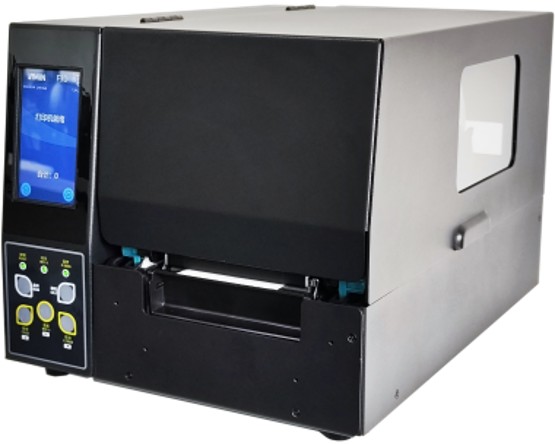
JT240TR
From High Volume, High-Precision Barcode to On-Metal RFID Thickness, with Versatile Media Compatibility, Software & Tool Offered
300dpi / 600dpi UHF RFID EPC Gen-2 Thermal Transfer Design
Why Choose JT240TR
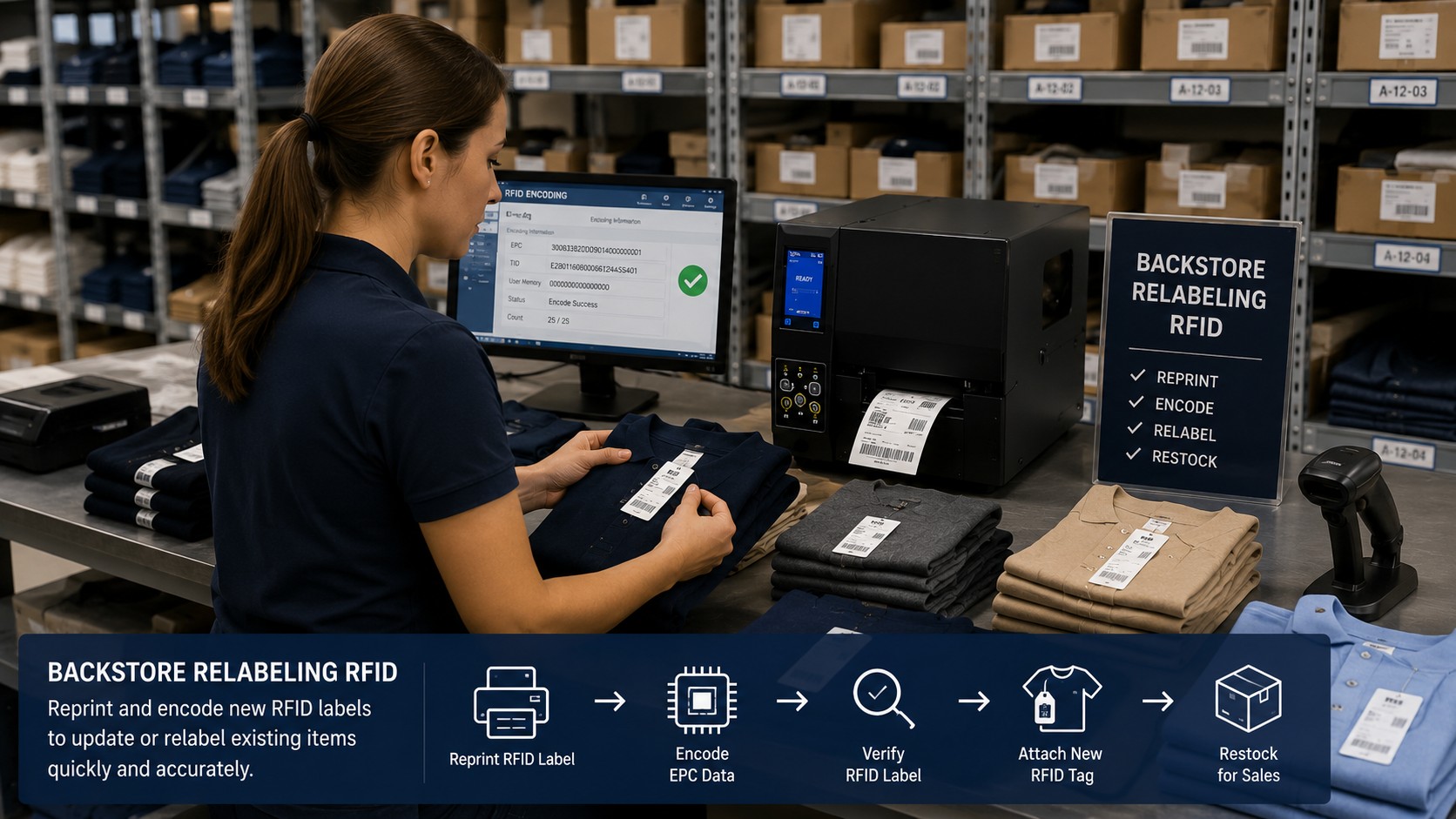
The Industrial UHF RFID Printer for High-Volume Encoding
Built for 5,000+ labels per day. 4.3″ IPS touchscreen. Prints on-metal tags up to 1.5mm. Free software included.
5,000+ Labels Per Day
Industrial-grade throughput for distribution centers, warehouses, and high-volume tagging operations.
4.3″ IPS Touchscreen
Full-color intuitive interface. Configure, monitor, and troubleshoot directly on the printer — no PC required.
Free Label Design Software
LabelSoft is permanently free — design, encode, and print without annual license fees.
1.5mm Media + 600 dpi
Print on on-metal RFID tags with high precision. Handle the widest range of label constructions in one machine.
Ideal For —
- High-volume UHF RFID encoding (5,000+ labels/day)
- Distribution centers and warehouse tag issuance
- Third-party logistics (3PL) RFID compliance labeling
- On-metal asset tagging at industrial scale
- System integrators deploying large-scale RFID solutions
⚠️ Consider Alternatives If —
The JT240TR series industrial UHF RFID printer is designed to deliver continuous, high-volume RFID labeling and encoding in demanding operational environments.
Built on a robust print engine and optimized for extended duty cycles, it enables organizations to scale RFID deployment from pilot applications to production-level operations across manufacturing, logistics, and distribution environments.
Designed to support diverse labeling requirements with RFID & Label Design Software offered to use, RFID Configuration & Calibration Tool to simplify RFID setup and fine-tune encoding performance, and Development Tool for Integration to enable customization and integration with enterprise applications.
While maintaining the same flexible printing and software capabilities as the desktop platform, the industrial model is engineered to support non-stop operation, higher throughput, and long-term reliability, making it ideal for mission-critical workflows where performance and consistency are essential.
Key Features
- One Platform for All RFID Labeling Scenarios
- Support 203 / 300 / 600 dpi in a single industrial printer, enabling high-volume tagging, RFID labeling, and high-precision applications without changing hardware, reducing SKU complexity and adapting to different use cases over time.
- Enable RFID in High-Density and Space-Constrained Applications
- The 600-dpi printing ensures clear, scannable output on small or data-dense labels, expanding RFID deployment into applications such as healthcare UDI, electronics, and small asset tagging, maintaining readability in small-label environments, supporting high-density 2D codes and micro text, and meeting compliance requirements.
- Simplify RFID Deployment with One-Step Print and Encode
- Integrated RFID encoding and printing ensures data is written and printed in a single process, largely improving data accuracy and eliminating mismatches between label content and RFID chip data, helping reduce manual operations, improve tagging consistency and increase operational efficiency.
- Support 1.5mm Thick and Specialty RFID Media for Industrial Applications
- Designed to handle a wider range of label constructions, including thicker RFID tags, enabling printing for on-metal and rugged RFID labels that typically require industrial printers, extending RFID into MRO, asset tracking, and metal environments, reducing reliance on larger industrial devices and increasing flexibility in tag sourcing.
- UHF RFID-ready for Smart Labeling Applications
- Built to support UHF RFID labels and compliant with EPC Class 1 Gen2 (ISO18000-6C), the JT240TR series is well suited for RFID-enabled identification, tracking, and compliance workflows. It operates in the 860–928 MHz range to support common UHF RFID deployment requirements.
- RFID and Label Design Software for Free
- Self-developed label editing, reading, writing, printing software: LabelSoft, with Windows and Linux versions, supports use of printers without drivers.
- RFID Config / Calibration Tool and Development Tool
- Provides graphical RFID calibration tool, intuitively displaying the range of label positioning waveform and RFID signal, one-key calibration, very convenient. A variety of development packages support VC, C#, Java, HTML5 and other mainstream programming languages.
Specifications
| Models | JT240TR-F2, JT240TR-F3, JT240TR-F6 |
|---|---|
| Printing Method | UHF RFID, Direct thermal & Thermal transfer |
| Resolution | JT240TR-F2: 203 DPI (8 dots/mm); JT240TR-F3: 300 DPI (11.8 dots/mm); JT240TR-F6: 600 DPI (24 dots/mm) |
| Max. Print Speed | JT240TR-F2/F3: 8 IPS (203.2 mm/s); JT240TR-F6: 3 IPS (76.2 mm/s) |
| Max. Print Width | JT240TR-F2: 4.25" (108 mm); JT240TR-F3/F6: 4.15" (105.6 mm) |
| Max. Print Length | JT240TR-F2: 157.5" (4000 mm); JT240TR-F3/F6: 78.7" (2000 mm) |
| Memory | 32 MB Flash ROM, 16 MB SDRAM |
| Media | Roll-feed, die-cut, continuous, fan-fold, tags, tickets in plain paper or thermal paper; Width: 4.6" (118 mm) max., 0.8" (20 mm) min.; Supply roll: OD 5" (127 mm) max., ID 1" (25.4 mm) min.; Thickness: 0.06–1.5 mm (0.002–0.06"), including liner, support flexible on-metal tag |
| Ribbon | Wax, Wax/Resin, Resin; Ribbon roll: OD 2.75" (70 mm) max. with ID 1" (25.4 mm) core or ID 0.5" (12.7 mm) core; Max width: 110 mm; Max length: 300 M |
| Media Sensor | Adjustable reflective & Transmissive |
| RFID Function (option) | UHF: High performance RFID reader/encoder, supports various labels compatible with EPC Gen 2 / ISO 18000-6C; OR HF: Support ISO/IEC 15693/14443A/NFC/UltraLight protocol, support write ASCII, hexadecimal, NDEF format text or URL address, support tag encryption and locking |
| Bar Code Types | 1D: Code 39, Code 93, Code 128, Codabar, EAN-8/13/128, Interleave 2 of 5, UCC-128, UPC A/E 2 and 5 add-on, etc.; 2D: Data Matrix, MaxiCode, PDF417, QR, etc. |
| Interfaces | USB, Ethernet |
| Input Key | Five Input Key |
| LED | Three LED indicator lights |
| Display | 4.3" IPS touch screen (480×800) |
| Power Supply | 85 ~ 264 VAC, 47 ~ 63 Hz, 150 W |
| Weight | 12.5 KGS |
| Dimensions | W299 x D410 x H270 mm |
| Operation Environment | Temperature: 32°F ~ +104°F (0°C ~ 40°C); Relative humidity: 5% - 85% non-condensing |
| Storage Environment | Temperature: -40°F ~ +140°F (-40°C ~ 60°C); Relative humidity: 5% - 85% non-condensing |
| Options | Peeler |
| Software & Tools | LabelSoft Designer – Windows and Linux supports use of printers without drivers; RFID calibration tool – One-key calibration and Graphical Display; Development Package - supports VC, C#, Java, HTML5 and other programming languages |
Applications
- Retail: In-store exception tag printing, Apparel and merchandise tracking, Jewelry / luxury in-store labeling, Retail pharmacy bag manufacturing
- Government: Document tracking, Evidence tracking, Asset management, Ticketing
- Healthcare: Sample and laboratory specimen tracking, Patient identification, Hospital pharmacy
- Hospitality: Asset tracking, RFID wristbands
- Manufacturing / Industrial: Work-in-process tracking, Parts and asset labeling, On-metal asset management
- Food & Beverage: Expiration date tracking, Food safety recall
Technical resources
Free technical guides for this decision
At 5,000 labels a day, batch variance stops being an abstraction: two rolls of the same inlay can behave differently, and the cause sits upstream of the printer. The field reference is written to be printed and pinned next to the machine:
- Seven operating rules — the rules that keep an industrial line honest, including VOID-rate trending and re-testing after a firmware change
- Six numbers that change decisions — including why a 100 % single-pass read rate cannot be promised — and what to write into the contract instead
The full 33-page buyer's guide (PDF) carries the reasoning and the eight-symptom troubleshooting matrix; the on-metal guide (18 pages, PDF) covers the media side.
FAQ
Questions buyers ask before they order
Why do some labels come out marked VOID?
A VOID label means the encoder wrote the data, read it back, found a mismatch and refused to release the label. Dead or marginal chips and antennas damaged in converting are a normal fact of media supply, so a scattered low single-digit VOID rate is the safety net working rather than a printer fault. At industrial volumes the number itself matters less than its trend: log VOID rate per roll, and treat a step-up after a media change as a supply signal.
How do I confirm the labels I received use the chip I ordered?
Read the TID of a sample label. Its leading bytes identify the silicon — for example, E280 1191 is an Impinj M730 and E280 6995 is an NXP UCODE 9. Labels that look identical can carry different chips, and the printed label says nothing. At 5,000 labels a day, make the sample TID read a written receiving step rather than something an operator remembers to do.
What should I check before placing a bulk media order?
Converted label rolls rather than dry inlays; inlay pitch at or above 16 mm; documented a/x/y placement dimensions; the chip on the printer's supported firmware list at your firmware version; media thickness inside the JT240TR's 1.5 mm rating; a 100-label encode-and-verify trial on one test roll; and a converter who will put the placement guideline and a per-delivery batch record in writing. At this volume one undocumented media change costs more than the media.
How many labels per day is the JT240TR built for?
It is specified for 5,000+ labels per day. That figure is about duty cycle and head life as much as speed: an industrial chassis and print mechanism are sized to run continuously, where a desktop unit is sized for bursts. If your peak is a few hundred labels a day, the desktop JD240TR is the better match and the budget is better spent on media.
What is the difference between the JT240TR and the JD240TR?
Throughput and interface, mostly. The JT240TR is rated for 5,000+ labels per day and carries a 4.3-inch IPS touchscreen so it can be configured, monitored and troubleshot at the machine without a PC. The JD240TR is the desktop workhorse for retail-scale volumes. Both offer the 600 dpi option, and both accept media up to 1.5 mm for flexible on-metal labels.
Which RFID applications are hardest to get right?
Ranked from hardest: on-metal assets, where metal detunes a standard antenna and interference nulls can reach −30 dB; then liquids and pharma, where water absorbs UHF energy; then laundry and high-temperature textiles; then dense stacking and curved packaging. Plain cartons and apparel are the easy case. Match the tag class to the surface and validate on the real product, never in free air.
Ready to evaluate JT240TR?
Request a quote, evaluation terms, or a technical consultation.
Contact Us