
JNXRFID · Know-how Series · Deployment Reality KH‑004
The Datasheet Says Eight Metres, the Aisle Says Two
Read range is the most quoted and least transferable number in RFID. This article explains the four physical reasons a quoted range collapses in the field, how to tell them apart with cheap tests, and what to ask for instead of a distance figure.
14 min read · Applies to UHF passive RFID · Range, orientation and material effects · First edition, October 2026
The reader we were given is specified to read these tags at eight metres. In our aisle we get two. Is the reader faulty, and if not, how do we find out which physical factor is costing us the other six metres?
It is almost never the reader, and almost never one cause. A quoted range describes a tag, an orientation, a material and a free-space path. Change any of those and the number changes. What makes field results look mysterious is usually that three of the four changed at once, so no single test isolates any of them.
Four variables, not one number
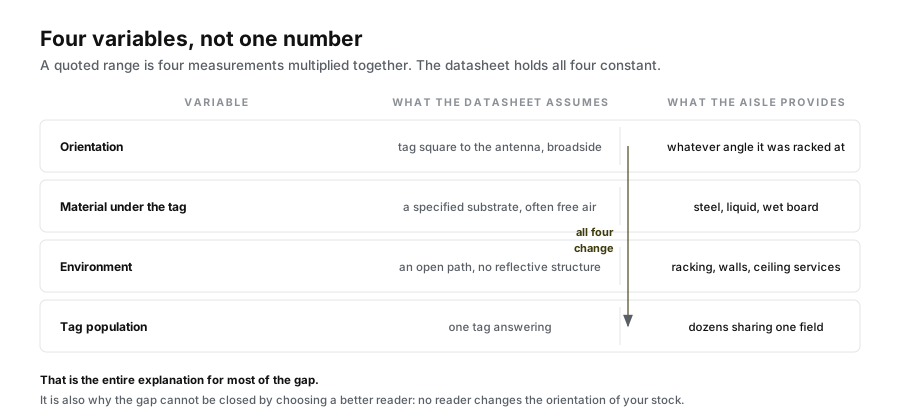
A range figure is really four measurements multiplied together:
| Variable | What the datasheet assumes | What the aisle provides |
|---|---|---|
| Orientation | Tag geometry square to the antenna, full broadside exposure. | Whatever angle the asset happened to be racked or handled at. |
| Material under the tag | A specified substrate, often free air or cardboard. | Steel, liquid, wet board, or a bundle of other tags. |
| Environment | An open path with no reflective structure. | Racking, walls, ceiling services and neighbouring equipment. |
| Tag population | One tag answering. | Dozens sharing the same field. |
A datasheet number holds all four constant. A deployment changes all four. That is the entire explanation for most of the gap, and it is why the gap cannot be closed by choosing a better reader.
Orientation is the largest single factor
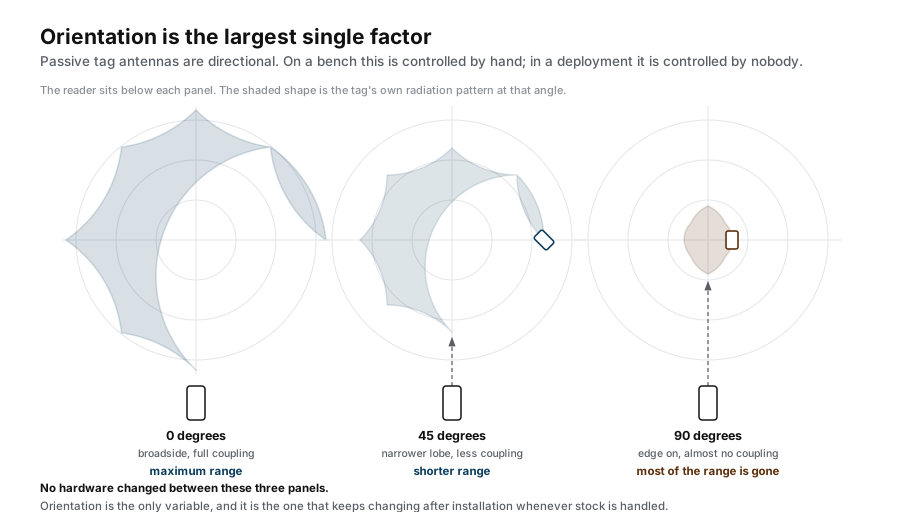
Passive tag antennas are directional. Presenting the tag broadside to the reader's field gives the strongest coupling; rotating it ninety degrees can remove most of the achievable range.
On a bench this is controlled by hand. In a deployment it is controlled by nobody, and it changes after installation whenever stock is handled. A pallet wrapped on a different side, a tool placed in a different rack position, or a case turned ninety degrees in a bin all move the tag out of the orientation it was measured in.
This is also the factor most often misdiagnosed as insufficient power, because both present as "it does not read far enough". The distinction is testable: a tag that reads reliably at close range and fails at distance is usually an orientation problem, and more power will not restore what the angle took away. It will, however, bring the far end of the zone closer, which is why the mistake persists.
Test to run this week
Take ten failing assets and read each one at a fixed short distance in four rotations: 0°, 45°, 90° and 135°. If the read rate swings sharply between rotations, orientation is your dominant variable and no reader decision will change the outcome. If it reads at all four angles, orientation is not your problem and you should stop spending time on it.
The material under the tag
A tag and the surface it is mounted on form one system. The tag has no battery: it harvests the reader's energy, and the surface behind it either lets that energy couple into the tag's antenna or absorbs and detunes it.
- Metal. A conventional inlay placed directly on metal is effectively shorted. On-metal constructions are built around a spacer precisely to avoid this. This is the subject of our on-metal tagging guide.
- Liquid and moisture. Water absorbs RF energy heavily. A chilled cabinet, a goods-in area with damp pallets and a bottled-product pallet all behave like a different material from the carton they are packed in.
- Dense packing. A tight bundle of tags couples the tags to each other as well as to the reader. Each tag detunes its neighbours, so a bundle can fail at a distance while the same tag alone reads fine.
Because material is a property of the asset rather than of the installation, failures here cluster by SKU. That clustering is the diagnostic signature, and it is why "group the failures" beats "upgrade the reader" as a first move.
Nulls, and why range is not a circle
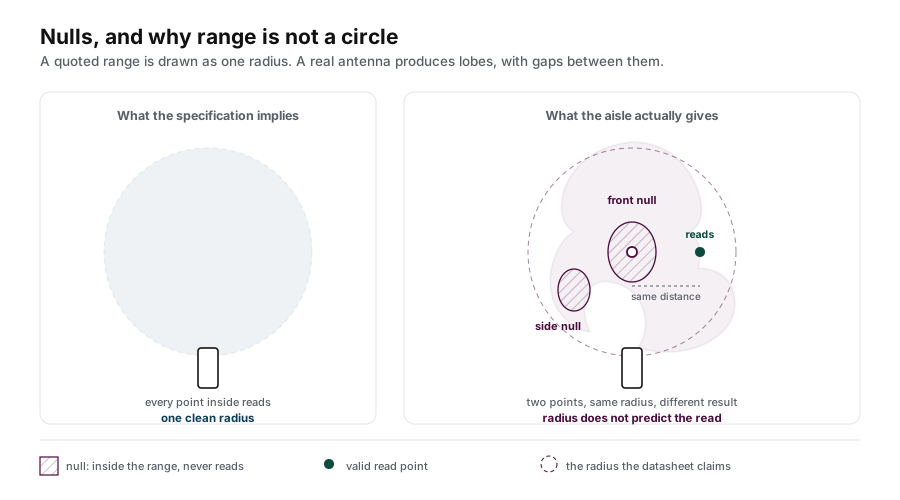
In a reflective room the direct wave to the tag and the wave reflected off nearby structure arrive slightly out of step. Where they cancel, the tag receives almost nothing and stops replying, regardless of distance. Those cancellation points are called nulls.
The behaviour that results is the one that generates most support tickets:
- A tag that reads reliably disappears at one specific position and returns a few centimetres away.
- Moving an asset one position along a shelf changes the result completely, with nothing else altered.
- Antennas that are each fine individually behave differently once both are powered.
None of this is a fault. It is the expected consequence of a reflected signal, and it is why a read range measured in an open room is not a number you can plan a warehouse with. It is also why "read distance" without a stated environment is not a specification, it is an anecdote.
How to measure a range you can plan with
A range that transfers to production is measured as a coverage boundary under stated conditions, not as a maximum distance for one lucky alignment.
- Fix the conditions and write them down. Tag model, asset material, mounting position, orientation and the stock situation in the zone. An unstated condition makes the number untransferable.
- Walk the boundary rather than measuring to a point. Move a tagged asset toward the antenna and record where reads stop. Repeat at several positions and several orientations.
- Report the distribution, not the maximum. The useful figure is the distance at which reads stay reliable, plus how often it varies. A site that reads to eight metres once and two metres usually is not an eight-metre site.
- Measure with the real population. A zone holding the tags it will hold in production is a different measurement from an empty zone, and it is the one that predicts throughput.
- State the power. A range without a transmit power is not a measurement, because the two trade off directly.
| Claim | What it establishes | What it does not |
|---|---|---|
| Maximum range, one tag, free space | An upper bound exists. | Say nothing about a loaded aisle. |
| Range at a stated power and orientation | A repeatable laboratory condition. | Cover reflective structure or tag density. |
| Coverage boundary with real assets and stock | A shape you can design a layout around. | Guarantee the same boundary in a different room. |
What to ask a supplier instead of a distance
- What surface was that distance measured on, and in what orientation?
- At what transmit power, and is the figure for one tag or a populated zone?
- How does the range change on metal and on liquid-filled assets?
- What does the field look like away from the axis, rather than along it?
- What is your procedure when a deployment reads worse than the quoted figure?
A supplier who quotes a distance should be willing to explain the room it came from. That question separates a measurement from a marketing number, and it is the cheapest one you can ask.
From diagnosis to a test plan
Buy a test plan before you buy hardware
Four variables cannot be separated by argument. They separate under four measurements: rotation, material, distance and density. Run them on your own assets and the quotation that follows is a specification rather than a hope.
- Run the four-rotation test on ten assets that actually fail in production.
- Record the surface and the tag construction for each failure group, not for the average.
- Send us the measurements; we will size the antenna, the reader and the label together instead of quoting a maximum distance.