
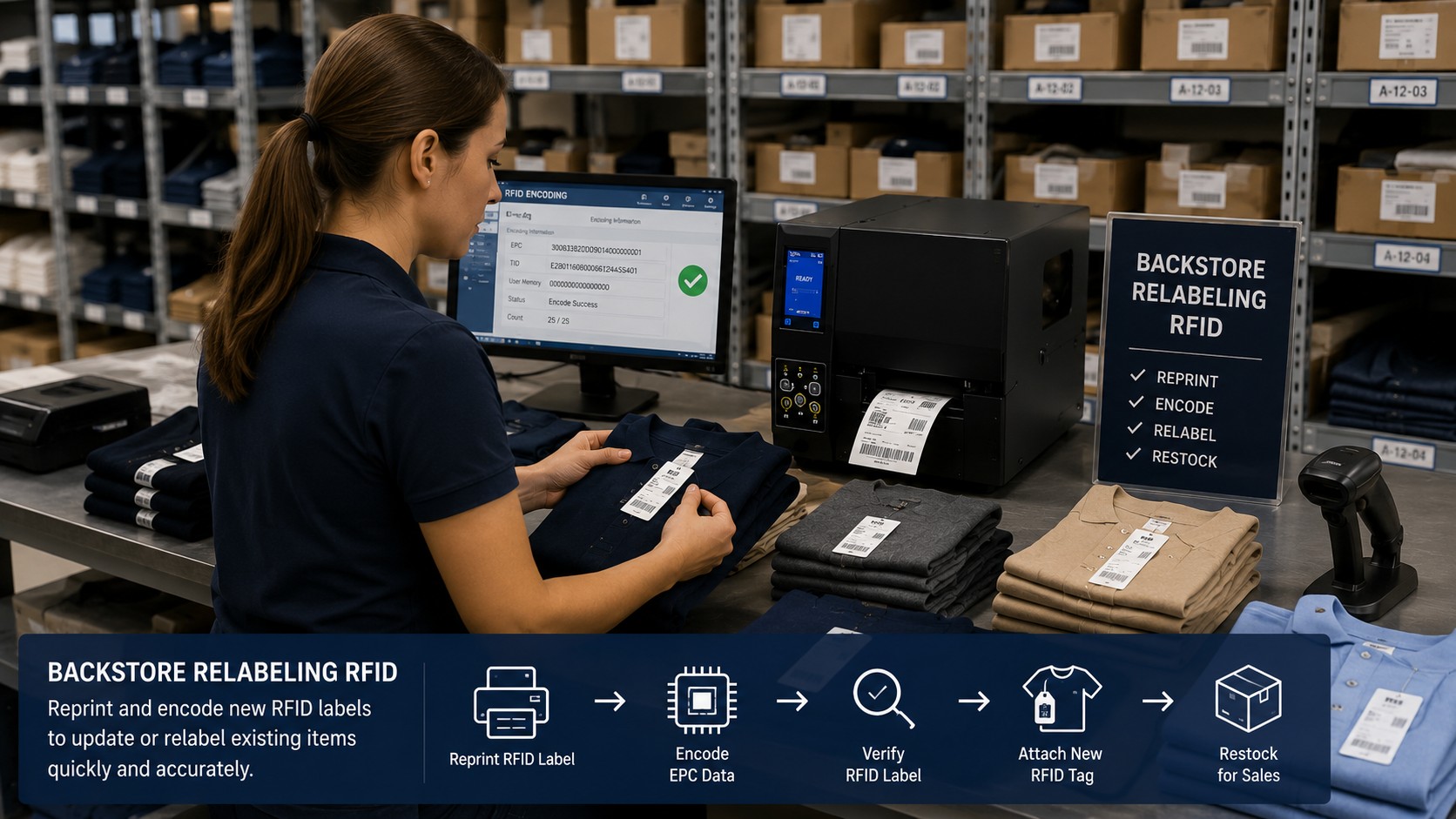
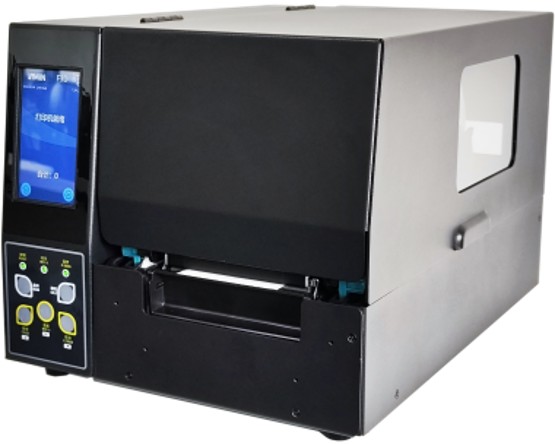
JT240THR
From High Volume, High-Precision Barcode to Anti-counterfeiting / Authentication and Controlled Short-Rage NFC (smartphone) compatibility, Software & Tool Offered
300dpi / 600dpi HF RFID ISO/IEC Thermal Transfer Design
Why Choose JT240THR
The Industrial HF/NFC RFID Printer for Secure Tagging at Scale
High-volume HF/NFC encoding with industrial throughput. 4.3" IPS touchscreen. Prints on-metal tags up to 1.5mm. Free software.
5,000+ Labels Per Day
Industrial-grade throughput for high-volume anti-counterfeiting, authentication, and secure tagging operations.
HF/NFC ISO Compliance
ISO 15693 / 14443A support. Compatible with smartphone NFC verification for brand protection and authentication. Industrial HF/NFC printing is rare in this class — a JNXRFID specialty.
4.3" IPS Touchscreen
Full-color intuitive interface. Configure, monitor, and troubleshoot directly on the printer — no PC required.
1.5mm Media + 600 dpi
Print on on-metal HF/NFC tags with high precision. Handle the widest range of secure label constructions.
Ideal For —
- High-volume HF/NFC RFID encoding (5,000+ labels/day)
- Brand protection and anti-counterfeiting at industrial scale
- Secure document and credential issuance
- Pharmaceutical serialization and authentication
- System integrators deploying large-scale HF solutions
⚠️ Consider Alternatives If —
The JT240THR series HF RFID industrial printing solution is designed to deliver continuous, high-volume RFID labeling and encoding for secure identification, authentication, and NFC-based applications through a fully integrated hardware and software platform.
It focuses on controlled interaction, secure data encoding, and item-level personalization, making it ideal for scenarios where accuracy, security, and user engagement are critical, such as access control, visiting issuance, healthcare labeling, ticketing, and high-value product authentication.
Designed to support diverse labeling requirements with RFID & Label Design Software offered to use, RFID Configuration & Calibration Tool to simplify RFID setup and fine-tune encoding performance, and Development Tool for Integration to enable customization and integration with enterprise applications.
While maintaining the same flexible printing and software capabilities as the desktop platform, the industrial model is engineered to support non-stop operation, higher throughput, and long-term reliability, making it ideal for mission-critical workflows where performance and consistency are essential.
Key Features
- One Platform for All HF RFID Labeling Scenarios
- Support 203 / 300 / 600 dpi in a single industrial printer, enabling high-volume tagging, HF labeling, and high-precision applications without changing hardware, reducing SKU complexity and adapting to different use cases over time.
- Enable HF RFID in High-Density and Space-Constrained Applications
- The 600-dpi printing ensures clear, scannable output on small or data-dense labels, expanding RFID deployment into applications such as healthcare UDI, electronics, and small asset tagging, maintaining readability in small-label environments, supporting high-density 2D codes and micro text, and meeting compliance requirements.
- Drive Authentication and Anti-Counterfeiting for High-Value Products
- Integrated HF RFID encoding and printing ensures secure product identification and NFC-based verification, typically applied for applications requiring unique item identity and authentication data, supporting 'tap-to-verify' via smartphones and enabling re-tagging for lost, damaged, or missing labels.
- HF RFID-ready for Secure Identification and Controlled Interactions
- Built to support ISO/IEC 15693/14443A/NFC protocol, the JT240THR is well suited for HF RFID-enabled secure identification and controlled interaction requiring intentional, short-range, and secure interaction, which could prevent accidental reads with tap-based operation, supporting secure chip technologies (e.g. encrypted HF / NFC chips) ideal for ID, payment, ticketing, and access control.
- RFID and Label Design Software for Free
- Self-developed label editing, reading, writing, printing software - LabelSoft with Windows and Linux versions, supports use of printers without drivers.
- RFID Config / Calibration Tool and Development Tool
- Provides graphical RFID calibration tool, intuitively displaying the range of label positioning waveform and RFID signal, one-key calibration, very convenient. A variety of development packages support VC, C#, Java, HTML5 and other mainstream programming languages.
Specifications
| Models | JT240THR-F2, JT240THR-F3, JT240THR-F6 |
|---|---|
| Printing Method | HF RFID, Direct thermal & Thermal transfer |
| Resolution | JT240THR-F2: 203 DPI (8 dots/mm); JT240THR-F3: 300 DPI (11.8 dots/mm); JT240THR-F6: 600 DPI (24 dots/mm) |
| Max. Print Speed | JT240THR-F2/F3: 8 IPS (203.2 mm/s); JT240THR-F6: 3 IPS (76.2 mm/s) |
| Max. Print Width | JT240THR-F2: 4.25" (108 mm); JT240THR-F3/F6: 4.15" (105.6 mm) |
| Max. Print Length | JT240THR-F2: 157.5" (4000 mm); JT240THR-F3/F6: 78.7" (2000 mm) |
| Memory | 32 MB Flash ROM, 16 MB SDRAM |
| Media | Roll-feed, die-cut, continuous, fan-fold, tags, tickets in plain paper or thermal paper; Width: 4.6" (118 mm) max., 0.8" (20 mm) min.; Supply roll: OD 5" (127 mm) max., ID 1" (25.4 mm) min.; Thickness: 0.06–1.5 mm (0.002–0.06"), including liner, support flexible on-metal tag |
| Ribbon | Wax, Wax/Resin, Resin; Ribbon roll: OD 2.75" (70 mm) max. with ID 1" (25.4 mm) core or ID 0.5" (12.7 mm) core; Max width: 110 mm; Max length: 300 M |
| Media Sensor | Adjustable reflective & Transmissive |
| RFID Function | High Frequency: Support ISO/IEC 15693/14443A/NFC/Ultra-Light protocol, support write ASCII, hexadecimal, NDEF format text or URL address, support tag encryption and locking |
| Bar Code Types | 1D: Code 39, Code 93, Code 128, Codabar, EAN-8/13/128, Interleave 2 of 5, UCC-128, UPC A/E 2 and 5 add-on, etc.; 2D: Data Matrix, MaxiCode, PDF417, QR, etc. |
| Interfaces | USB, Ethernet |
| Input Key | Five Input Key |
| LED | Three LED indicator lights |
| Display | 4.3" IPS touch screen (480×800) |
| Power Supply | 85 ~ 264 VAC, 47 ~ 63 Hz, 150 W |
| Weight | 12.5 KGS |
| Dimensions | W299 x D410 x H270 mm |
| Operation Environment | Temperature: 32°F ~ +104°F (0°C ~ 40°C); Relative humidity: 5% - 85% non-condensing |
| Storage Environment | Temperature: -40°F ~ +140°F (-40°C ~ 60°C); Relative humidity: 5% - 85% non-condensing |
| Options | Peeler |
| Software & Tools | LabelSoft Designer – Windows and Linux supports use of printers without drivers; RFID calibration tool – One-key calibration and Graphical Display; Development Package - supports VC, C#, Java, HTML5 and other programming languages |
Applications
- Authenticity Re-Labeling / Replacement Tagging: Luxury goods and premium retail (bags, watches, jewelry, apparel, electronics and high-value devices), Pharmaceutical products encoding, Certified or serialized goods
- Temporary Visiting & Access Control: Company visitor access badges, Facility ID / eID badges, Campus and student badges, Data center access credentials
- Serialization and NFC Secure Encoding: Smart packaging and marketing tags, URL / digital identity, Consumer engagement
- Wristband & Healthcare Labeling: Patient wristbands, Event and access wristbands
- Library & Document Tracking: Library book tagging, Archive management, Document tracking systems
Technical resources
Free technical guides for this decision
Industrial HF/NFC encoding at volume is unusual, and so is the media it runs on. Two guides cover the two halves of that problem — the construction and the encoding:
- The validation protocol — how to prove an HF/NFC on-metal programme works when no third-party certificate covers the converted label
- The pre-purchase checklist — 22 lines to take into any vendor meeting, grouped so you can work through them in order
Start with the on-metal guide (18 pages, PDF); the printer-encoder guide (33 pages, PDF) adds the encoding, media and data rules.
FAQ
Questions buyers ask before they order
Why do some labels come out marked VOID?
A VOID label means the encoder wrote the data, read it back, found a mismatch and refused to release it. HF/NFC inlays fail for the same physical reasons as any other tag — dead silicon, antennas damaged in converting — so a scattered low single-digit rate is normal. On a secure-tagging line the trend is the signal: log VOID per roll, and investigate a step-up after a media change before you suspect the printer.
How do I confirm the labels I received use the chip I ordered?
Read a sample from the roll and confirm the silicon matches what you ordered. On HF/NFC that means reading the tag's unique identifier rather than a Gen2 TID bank; the purpose is identical. Labels that look alike can carry different chips, and the printed label says nothing. Where the tag itself is the proof of authenticity, a receiving check belongs to the security model, not to procurement housekeeping.
What should I check before placing a bulk media order?
Converted label rolls rather than raw inlays; inlay placement dimensions documented by the converter with tolerances; the chip on the printer's supported firmware list at your firmware version; media thickness inside the JT240THR's 1.5 mm rating, including HF/NFC on-metal constructions; whether the tags arrive pre-locked and the access keys if they do; and a 100-label encode-and-verify trial before you scale to production volume.
How many labels per day is the JT240THR built for?
It is specified for 5,000+ labels per day, with a 4.3-inch IPS touchscreen for configuration and troubleshooting at the machine. Industrial HF/NFC encoding at that volume is unusual — most HF work is done at a bench or on a desktop unit — which is the gap this model fills.
What is the difference between the JT240THR and the JD240THR?
Volume and interface. The JT240THR is rated for 5,000+ labels per day and has an on-machine touchscreen; the JD240THR is the desktop unit for smaller secure-tagging runs. Both support ISO 15693 / 14443A, and both accept media up to 1.5 mm for on-metal HF/NFC labels.
Does an ARC-certified inlay matter to me?
ARC is a third-party programme run by the Auburn University RFID Lab. It certifies that an inlay model meets defined performance requirements and that its maker can reproduce that at volume, and it is the reference standard behind several large retail programmes. Two limits matter here: it covers the inlay and its maker, not the converted label, and specialty media such as on-metal or authentication constructions are usually outside such programmes altogether. There, what protects you is a placement guideline with tolerances, a layer-stack datasheet and a per-batch encode-and-verify sample.
Ready to evaluate JT240THR?
Request a quote, evaluation terms, or a technical consultation.
Contact Us