
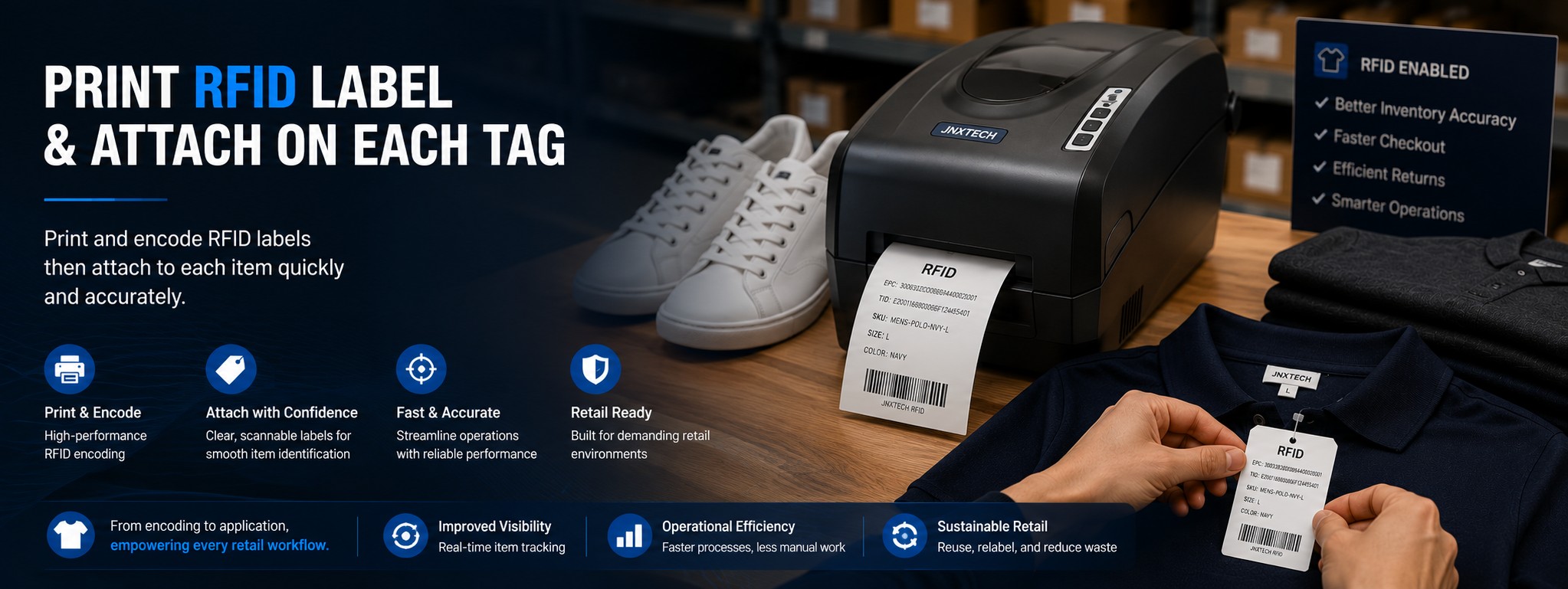
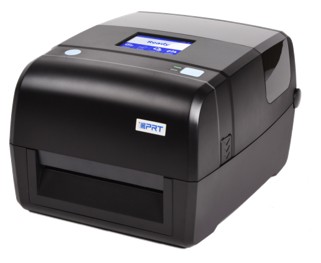
T430R
Small Form-factor, Easy to Deploy and Budget Effective
300dpi Option Thermal UHF RFID 128MB & 256MB Compatible
Why Choose T430R
The Entry-Level UHF RFID Printer
A budget-friendly UHF RFID printer for light-volume tag encoding. Compact, simple, and easy to deploy.
Most Affordable Option
The lowest-cost UHF RFID printer in the JNXRFID lineup. Ideal for getting started with RFID tagging on a budget.
Compact Footprint
308 × 250 × 180 mm. Fits easily on any retail counter or workspace without dominating the surface.
Free Label Design Software
LabelSoft is permanently free. No annual license fees — a significant saving for small deployments.
Plug and Print
Simple USB-C connectivity. Minimal setup. Start encoding UHF RFID labels in minutes.
Ideal For —
- Light-volume UHF RFID tag encoding (< 500 labels/day)
- Small retail stores testing RFID for the first time
- Budget-conscious deployments with basic tagging needs
- Standard barcode + RFID label printing
⚠️ Consider Upgrading If —
The T430R UHF RFID Label Printer is designed to deliver reliable RFID label printing with precise media positioning, flexible media support, and easy day-to-day operation. Its dual-sensor design helps improve print accuracy, while automatic 203 dpi / 300 dpi recognition simplifies setup.
With a modular printhead, generous memory, broad media compatibility, and built-in encoder support for UHF RFID labels, the T430R offers a practical and durable solution for smart labeling applications in retail, logistics, manufacturing, healthcare, and compliance-driven environments.
Key Features
- Accurate Positioning for Reliable RFID Label Printing
- Features a unique dual front-and-rear sensor design that helps ensure precise media positioning and stable label handling, improving print accuracy and supporting efficient RFID label production across a wide range of applications.
- Support 203 dpi and 300 dpi Printhead Auto Recognition
- Automatically recognizes 203 dpi and 300 dpi printhead resolution, reducing setup complexity and eliminating the need for manual PC-side configuration, making deployment easier and helping users switch between resolution options more efficiently.
- Large Memory Capacity for Demanding Label Tasks
- With a 32-bit RISC CPU, 128 MB RAM, and 256 MB Flash memory, the T430R offers ample processing and storage capacity for label formats, fonts, graphics, and RFID printing tasks, supporting smoother operation in day-to-day industrial and commercial use.
- Modular Printhead Design for Easy Maintenance
- Modular printhead structure is designed for easy removal and installation, helping simplify maintenance and reduce service downtime, making routine replacement and servicing more convenient for operators and technical teams.
- Broad Media Compatibility for Flexible Application Needs
- Supports a wide variety of media types, including die-cut, fanfold, notch, roll, black mark labels, and receipt media. Supports media widths from 25.4 mm to 120 mm, making it suitable for broad labeling requirements across different industries.
- UHF RFID-ready for Smart Labeling Applications
- Built to support UHF RFID labels and compliant with EPC Class 1 Gen2 (ISO18000-6C), the T430R is well suited for RFID-enabled identification, tracking, and compliance workflows. It operates in the 860–928 MHz range to support common UHF RFID deployment requirements.
- Flexible Connectivity for Integration into Existing Systems
- Standard interfaces include USB-B, USB Host, Ethernet, with optional Bluetooth 4.0 / BLE and Wi-Fi, giving users flexible options for standalone use or integration into existing workflows and network environments.
- Easy Label Design Compatible with BarTender Software
- Comes with BarTender Ultralite label design software, allowing users to create and edit labels more easily without needing complex development resources, helping speed up setup and day-to-day label creation.
Specifications
| Printing Method | Thermal Transfer |
|---|---|
| Resolution | 203 dpi (8 dots/mm), 300 dpi (12 dots/mm) |
| Print Speed | 200 mm/s (203 dpi), 150 mm/s (300 dpi) (RFID encoding area) |
| Max Print Width | 108 mm (203 dpi), 106 mm (300 dpi) |
| Max Print Length | 2886 mm (203 dpi), 2524 mm (300 dpi) |
| Processor | 32-bit RISC CPU |
| Memory (RAM) | 128 MB |
| Flash Memory | 256 MB |
| RFID & Sensors | RF tag detection, paper out detection, gap, notch, black mark detection |
| RFID | UHF RFID, 860–928 MHz, EPC Class 1 Gen2 Standard (ISO18000-6C) |
| User Interface | Dual-colour LED (Status / Error), Feed button |
| Interfaces | USB-B, USB Host, Ethernet; Optional Bluetooth 4.0 / BLE, Wi-Fi |
| Media Type | Die-cut, fanfold, notch, roll type, black mark labels or receipt |
| Media Width | 25.4 mm – 120 mm |
| Media Length | 20 mm – 250 mm |
| Media Thickness | 60 µm – 250 µm |
| Roll Diameter | Max 127 mm |
| Core Size | 12.7 mm / 25.4 mm / 38 mm |
| Ribbon Type | Wax, Wax/Resin, Resin |
| Ribbon Width | 30 mm – 110 mm |
| Ribbon Length | Max 300 m |
| Ribbon Core Size | 25.4 mm |
| Power | Input AC 100–240V, 50/60 Hz; Output DC 24V / 2.5A (peak 9A) |
| Operating Environment | 5°C to 40°C, 30%–85% RH (non-condensing) |
| Storage Environment | -20°C to 50°C, 10%–90% RH (non-condensing) |
| Dimensions | 308 × 250 × 180 mm (L × W × H) |
| Weight | 2.85 kg |
| Accessories | External label holder (10" OD), cutter module, peeler module |
| Programming | ZPL, DPL, EPL, TSPL |
| Driver Support | Windows 7 and later, Linux |
| Fonts & Language Support | Bitmap Fonts 6, 8, 12, 16, 32, OCR A, OCR B; Font Rotation 0°, 90°, 180°, 270°; Font Scaling Horizontal & Vertical scaling up to 10×; Monotype CG Triumvirate scalable fonts; Simplified Chinese font; DOS437, 720, 737, 755, 775, 850, 852, 855, 856, 857, 858, 860, 862, 863, 864, 865, 866, Windows 1250–1258, ISO8859-1, -2, -3, -4, -5, -6, -8, -9, -15 |
| Barcodes | 1D: Code 39, Code 93, Code 128UCC, Code 128 subset A/B/C, Codabar, Interleave 2 of 5, EAN-8, EAN-13, EAN-128, UPC-A, UPC-E, EAN and UPC 2 (5) digits add-on, MSI, PLESSEY, POSTNET, RSS-Stacked, GS1 DataBar, Code 11; 2D: PDF417, Maxicode, DataMatrix, QR Code, Aztec |
| Regulatory Compliance | CCC, CE, FCC, CB, WEEE, RoHS |
Applications
- Retail: In-store exception tag printing, Apparel and merchandise tracking, In-store labeling
- Government: Document tracking, Evidence tracking
- Healthcare: Sample and laboratory specimen tracking, Patient identification, Hospital pharmacy
- Hospitality: RFID wristbands, Asset tracking, Ticketing
- Manufacturing / Industrial: Work-in-process tracking, Carton / pallet load tracking, Parts and asset labeling
- Food & Beverage: Expiration date tracking, Food safety recall
Technical resources
Free technical guides for this decision
The T430R is the entry point: full UHF Gen2 encoding and free LabelSoft design software, without the 600 dpi option or the thick-media rating. If you are weighing that trade-off, start here:
- The pre-purchase checklist — 22 lines covering media, chip, encoder and validation — the shortest path from a pilot to a repeatable process
- The fifteen myths — the assumptions that produce the most expensive wrong purchases, so you can check which ones you are holding
Not planning to on-metal tag yet? The 33-page buyer's guide (PDF) is written for exactly this stage; the on-metal guide (PDF) is there for when that day comes.
FAQ
Questions buyers ask before they order
Why do some labels come out marked VOID?
A VOID label means the encoder wrote the data, read it back, found a mismatch and refused to release the label. Write-then-verify is a function of the encoder, not of the price bracket, so the T430R rejects bad labels exactly as a larger machine does. A scattered low single-digit VOID rate is normal media yield; escalate when failures cluster or repeat at the same roll position.
How do I confirm the labels I received use the chip I ordered?
Read the TID of a sample label. Its leading bytes identify the silicon — for example, E280 1191 is an Impinj M730 and E280 6995 is an NXP UCODE 9. Labels that look identical can carry different chips, and the printed label says nothing. On a first RFID deployment the temptation is to skip this; it is a two-minute check that prevents a year of blaming the printer.
What should I check before placing a bulk media order?
Converted label rolls rather than dry inlays; inlay pitch at or above 16 mm; documented a/x/y placement dimensions; the chip on the printer's supported firmware list; media thickness inside the printer's rating; and a 100-label encode-and-verify trial on one test roll before you scale. On an entry-level deployment that last item matters most: one test roll is what separates a working pilot from a pallet of labels nobody can read.
Can the T430R print on-metal RFID labels?
No, and it is better to know that now. The T430R is rated for standard label stock. Flexible on-metal labels run about 1.3–1.5 mm thick and need a machine specified for that media class. If metal assets are on your roadmap, the JD240TR is the model to look at — otherwise you will buy twice.
What do I give up by choosing the entry-level model?
Three things: the 600 dpi resolution option, the thick-media rating that allows on-metal labels, and industrial throughput. What you keep is the part that matters for a first deployment — full UHF EPC Gen2 encoding, write-then-verify, and LabelSoft design software at no licence cost. If your volumes are light and your labels are ordinary stock, none of the three is a loss.
When should I move up from the T430R?
When one of three things becomes true: your daily label volume outgrows a desktop unit; your artwork needs 600 dpi for small formats or dense 2D codes; or you start tagging metal assets. Each is a different upgrade — volume and resolution point to the JD240TR or the JT240TR, while on-metal media rules the T430R out entirely.