
JNXRFID · Know-how Series · Deployment Reality KH‑006
The Count Is Right and the Line Is Still Moving
A correct count that arrives too late to keep the line moving is not a counting problem. It is a throughput problem, and throughput is set by how many tags are in the zone at once, not by how fast one tag is read.
13 min read · Applies to UHF passive RFID · Tag density, anti-collision and read-point throughput · First edition, October 2026
Our counts are correct. Every pallet is eventually read, nothing is missed, and the report matches. But the line still waits at the read point, and the gap between the pallet arriving and the result appearing keeps growing. The reader is the newest thing we bought. What is actually making it slow?
A count that is eventually right is not the same as a count that is fast enough to let the line continue. When many tags are in one read zone at the same time, the reader cannot read them simultaneously: it detects the collision, selects one tag, asks the others to wait, and repeats. Every repeat costs a full round trip, so the time to clear a zone grows with the number of tags in it. The reader is not failing and nothing is being missed. It is spending its capacity on repetitions, and it looks like a slow reader because the queue is invisible from the outside.
Correct is not the same as fast
The symptom is worth stating precisely, because it is regularly misread as a broken installation. Nothing is missed. Every pallet is eventually read, and the report is right. What changes is the delay: the pallet has already moved on by the time the result appears, and at the busiest moment that delay is long enough to stop the line.
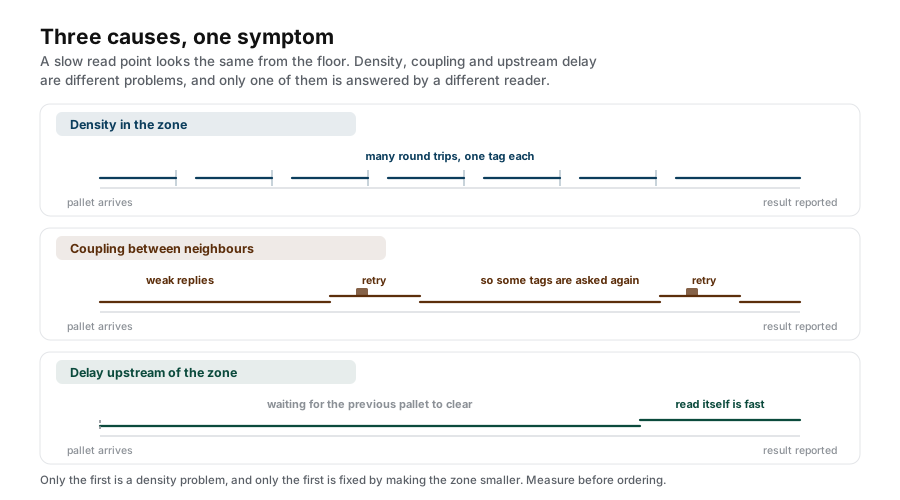
Three different causes produce this same visible symptom, and they need three different answers:
- The zone holds too many tags at once. A read zone that is generous in coverage is also generous in the number of tags it asks about in a single pass.
- The tags are close enough to interfere with each other. A tight bundle of labels couples them to one another, and each tag detunes slightly when it is next to its neighbours.
- The read point is downstream of something slower. The reader is fast; the pallet lifter, the conveyor gap or the encoder that produced the labels is not.
Anti-collision is a queue, and every queue costs time
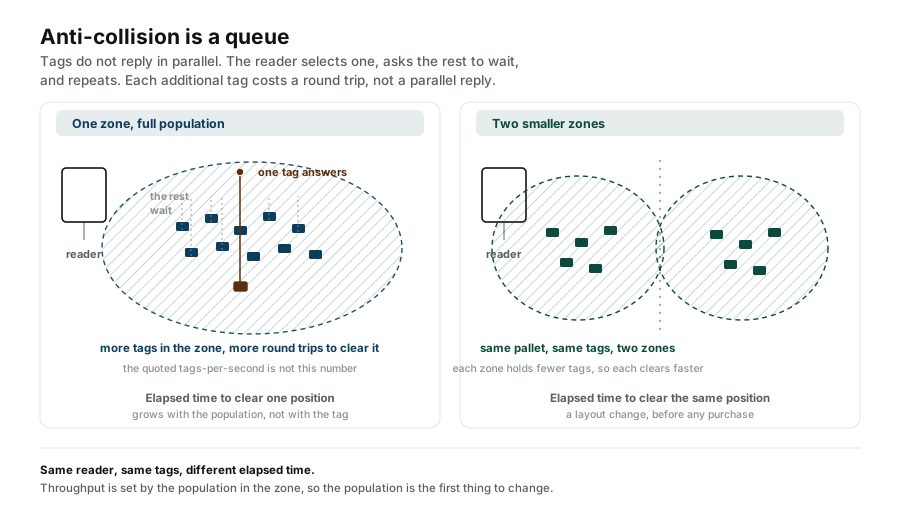
The EPC Gen2 air interface is built for a dense world. When several tags answer in the same instant, the reader detects the collision, selects one tag, and asks the rest to hold. It reads the selected tag, then repeats for the next. This is the Q algorithm: the reader works through the population one tag at a time, and the number of round trips grows with the number of tags present.
This is why a quoted tags-per-second figure is a ceiling, not an expectation. It describes the rate at which the reader can process replies when it is not fighting other tags for the same instant. The same reader against a denser population takes proportionally longer, because each additional tag adds a round trip rather than adding a parallel reply.
Two further mechanisms compound it:
- Tag-to-tag coupling. When valuable items are stacked or bundled tightly, their antennas interact and detune. A tag that reads on its own can fail when it is next to its neighbours, which turns a throughput problem into an apparent read-rate problem.
- An oversized zone. One antenna covering a full pallet position also covers whatever is beside it. Dividing a large field into several smaller zones usually raises throughput more than any hardware change, because each zone clears faster.
Measure the lag before you change anything
The measurement that matters is not a read rate quoted in a datasheet. It is the time between a tag entering the zone and its result appearing, measured with the real population present. Four numbers separate the three causes above, and each one points at a different decision.
| Measure | How | What it separates |
|---|---|---|
| Time to clear one pallet position | Time from the leading edge entering the zone to the last tag reported, with the real load in place. | Whether the read point is the constraint at all. |
| Tag count in the zone | Count the labels actually in the position, including those hidden behind the first layer. | Density from everything else. This is the number the round trips scale with. |
| Read rate in a sparse zone | Repeat the same measurement with one tag per position. | Whether the reader or the environment is limiting the reply. |
| Interval between pallet movements | Measure the gap the process actually leaves, not the gap the layout intends. | Whether the delay upstream of the zone is the real constraint. |
Run the first and third together. If the sparse-zone rate is close to the manufacturer's figure and the loaded rate is far below it, the cause is density or coupling, and the answer lies in the zone and the population, not in the reader. If the sparse rate is also low, the environment or the tag construction is involved, and that is a different article.
What actually raises throughput
Once density is confirmed as the cause, the controls are ordered by what they change. Reading them in the wrong order is expensive, because a hardware change is the last step, not the first.
- Reduce the tag count per zone. Read a defined zone rather than a generous one. Fewer tags per zone means fewer round trips, and it is a layout change rather than a purchase.
- Remove the coupling. Separate the labels physically, or change to a construction that is not affected by a neighbour at close range.
- Give the read point somewhere to be. A read point positioned where pallets are forced to stop, rather than where they happen to pass, converts a moving target into a stationary one.
- Only then consider the reader. A reader with a higher quoted ceiling helps only when the zone, the population and the dwell are already settled. It does nothing for coupling, and it does nothing for a bottleneck that sits upstream of the antenna.
A diagnostic sequence that finds the constraint
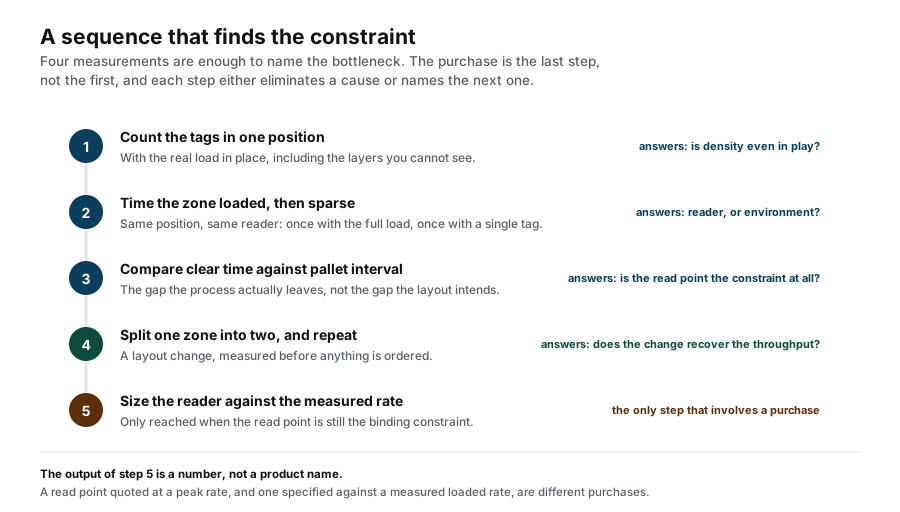
The steps below are the order that wastes the least. Each one either eliminates a cause or names the next measurement, and none of them requires a purchase to be made first.
| Step | Action | Decision it produces |
|---|---|---|
| 1 | Count the tags in one pallet position with the real load in place. | Whether density is even in play. |
| 2 | Time the zone with the real load, then with a single tag per position. | Whether the read point or the environment is limiting the reply. |
| 3 | Compare the loaded time against the interval between pallet movements. | Whether the read point is the constraint on the line at all. |
| 4 | Split one zone into two and repeat the measurement. | Whether a layout change recovers the throughput. |
| 5 | Only if steps 1 to 4 leave the read point binding, size the reader against the measured rate. | Which reader, and what it must deliver. |
The output of step 5 is a number, not a product name. A read point quoted at a peak rate and specified against a measured loaded rate are different purchases, and the second one is the one that can be held to a specification.
What to specify when you buy
When the read point genuinely is the constraint, the specification has to describe a loaded zone rather than an empty one. Four fields decide it.
| Field | State it as | Why |
|---|---|---|
| Tag population per zone | The real count, including the layers you cannot see. | Round trips scale with the population present. |
| Required clear time | The elapsed time the position may occupy the zone. | It converts a throughput problem into a rate specification. |
| Zone geometry | The area the antenna must cover, and what it must not cover. | It fixes the population the reader has to resolve. |
| Operating environment | Steel racking, liquid, wet board, and the density of each. | It decides whether the reply rate is a radio question or a layout question. |
Ask for the figure to be quoted against a loaded zone, with the population stated. A supplier who quotes only a peak rate is telling you about an empty room. A supplier who quotes a rate at a stated population is telling you about yours.
From measurement to specification
Give us the loaded number, not the empty-room one
The measurement that settles this is the time to clear one zone with the real tag count in it, repeated with the pallets actually moving at your interval. Send us that and the population, and the reader, the antenna and the zone come back as a specification rather than a shortlist.
- Count the tags in one pallet position, and time the zone with the real load in place.
- Tell us the interval between pallet movements, and what the zone has to cover.
- Send us the loaded clear time; we will size the reader and the antenna against that number, not against a peak rate.