
Industry Solutions
Manufacturing & Industrial Tooling
Every tool back in its slot before the shift closes.
Where the day goes wrong
The shift opens with a search.
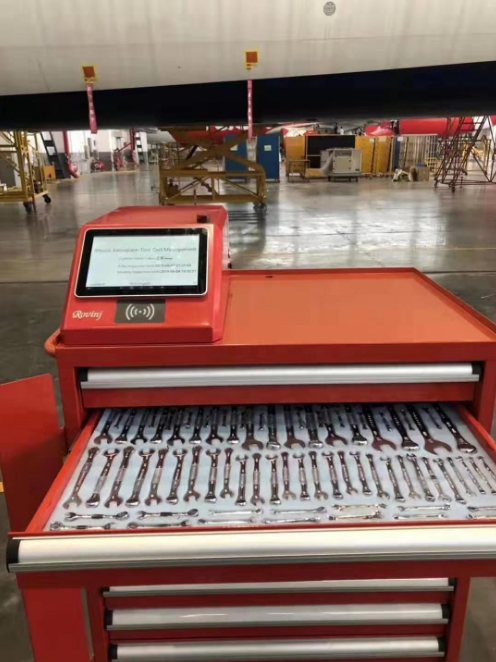
A torque wrench or a die set is not on the board where it should be. Two people walk the floor while the line waits, and the tool is re-ordered because nobody can prove it ever came back. A cabinet that reads what is inside, and who took it, closes that question at the door.
Why it is hardA cabinet read is a single inventory round: the reader issues a Select and an Inventory, and the tags inside answer in randomly chosen slots so that hundreds can be resolved without talking over one another. A tool that is not in its slot is then not a mystery - it is an identifier that the register expected and did not hear. The catch is that a steel tool laid flat on metal detunes the tag in front of it, so physical tag construction matters as much as the reader.
Our partOn-metal tag construction and a drawer set built to hold the tag clear of the tool are what make a steel tool readable at all, and the JNI-TM02 cabinet family records every take against the badge that opened it. At the end of the shift the board answers the actual question - what is still out - without anyone walking the floor.
Inspection still runs on paper.
Rounds are signed off on a clipboard and filed in a binder. When a machine fails, last week's check is somewhere in a folder. Scan the checkpoint and the history sits with the asset, ready for the next audit.
Why it is hardA checkpoint record is only worth what its identity is worth. The TID memory bank is written by the chip maker and permalocked, so a record bound to it cannot be quietly re-pointed at a different asset the way a written serial can. Each scan writes an identity and a time against the asset, and the history sits with the asset instead of in a binder.
Our partThe JMDS65 handheld covers the rounds, and a JNR-E401N with JNA series antennas covers a fixed station where the check happens in the same place every time. The record feeds the CMMS you already run - we do not replace it.
Keys leave without a name.
The key to a panel or a store walks off the desk and comes back with nobody attached to it, and an audit turns into guesswork. Issue and return against a badge, and every key carries an owner and a time.
Why it is hardIssue and return is an access-controlled transaction, not a count. The credential that opens the cabinet is the credential the take is written against, and one holder at a time means a second take on the same item surfaces as a conflict rather than as an unexplained shortage.
Our partThe JNI-K20A and JNI-K30A key cabinets hold that record at the cabinet, so the audit is a query rather than a reconstruction from notes.
How RFID reads a drawer
Tools are the least forgiving thing to tag in a plant, because most of them are made of the material that ruins UHF reads. A tag works by resonating against its own antenna, and a large metal surface next to that antenna shifts the resonance and kills the read; the fix is a tag built for metal, with a spacer and a ground plane so the metal becomes part of the design rather than an obstacle. Once that is solved, the cabinet does the rest in one pass.
- On-metal tag construction
- Unique EPC per tool, TID as chip identity
- Read rate set by the zone, not the tag
We supply the cabinets, the readers and the antennas, and we survey the drawer and the tool set before the order so the read is proven with your own tools.
What goes on the floor

Tool and instrument cabinets
Hold tools, power tools and instruments, and record every take.
JNI-TM02 · JNI-TM02-SY · JNI-TM02C-TGM · JNI-TM02M-07XJ · JNI-TM02M-BL14 · JNI-TM03C · JNI-TM03HZ
View the cabinet range


Line-side reading
Work-in-process between stations, with JNA series antennas.
JNR-E401N · JNR-E801N · JMDS65
View the JNR-E familyWhat hardware does this industry usually deploy?
A working configuration for this industry, taken from the equipment listed above. The band column gives the UHF RFID standards the hardware is built to.
| Role on site | Recommended models | UHF band | What it does |
|---|---|---|---|
| Tool and instrument cabinets | JNI-TM02 · JNI-TM02-SY · JNI-TM02C-TGM · JNI-TM02M-07XJ · JNI-TM02M-BL14 · JNI-TM03C · JNI-TM03HZ | 902-928 MHz (US) / 865-868 MHz (EU) | Hold tools, power tools and instruments, and record every take. |
| Key cabinets | JNI-K20A · JNI-K30A | 902-928 MHz (US) / 865-868 MHz (EU) | Log issue and return against a badge. |
| Smart shelves | JNI-TM08 · JNI-TM09 | 902-928 MHz (US) / 865-868 MHz (EU) | Keep count on open shelving. |
| Line-side reading | JNR-E401N · JNR-E801N · JMDS65 | 902-928 MHz (US) / 865-868 MHz (EU) | Work-in-process between stations, with JNA series antennas. |
How it runs
- Tool issue and return A badge opens the cabinet and the take is recorded, and at shift end the board shows what is still out.
- Inspection rounds Each checkpoint is scanned, and the record is tied to the asset and the time.
- Line-side capture Work-in-process is read as it moves between stations, so the count on the board matches the floor.
Questions we get
What stops a tool from being signed out twice?
Can it work without Wi-Fi on the floor?
Does it replace our CMMS?
Send us your tool list.
Tell us how many tools, cabinets and keys you manage, and we will size the cabinets and the read points.
Email support@jnxrfid.comRelated industries: Supply chain & logistics · Healthcare & hospital SPD · Apparel & fashion retail · New energy & utilities · Banking & archives · Public sector & public assets · Aviation MRO & ground support · Anti-counterfeiting & traceability · How we deliver
Contact: support@jnxrfid.com · All industry solutions